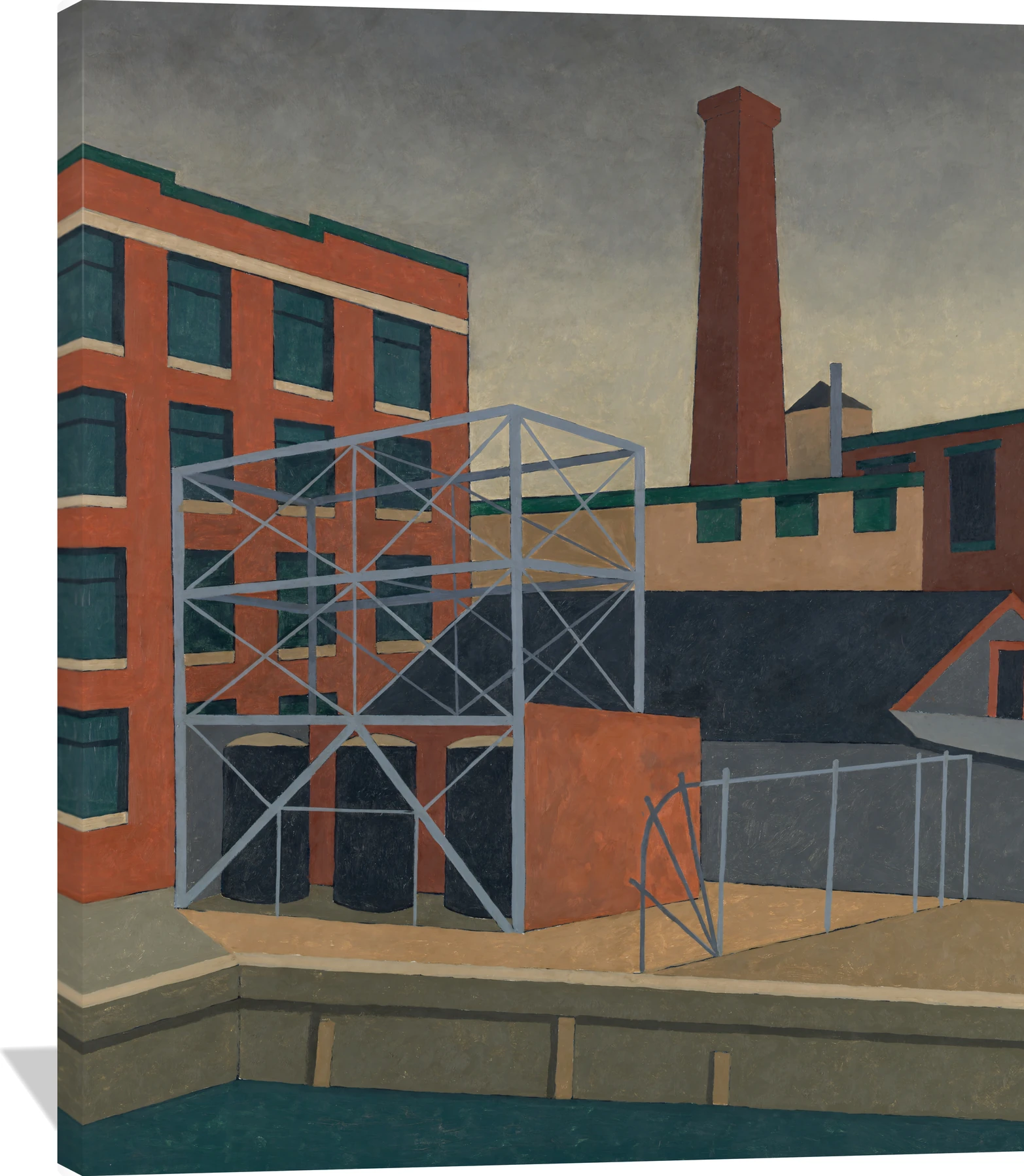
The Niles Spencer Waterfront Mill canvas captures the quiet geometry of American industry with striking precision. Bold planes of brick red, slate gray, muted teal, and ochre form a rhythmic composition of waterfront buildings under a softly clouded sky. Spencer’s modernist vision transforms utilitarian architecture into a study of balance, structure, and calm restraint.
This museum-quality canvas print brings a refined urban sensibility to any space. Its clean lines and subdued palette make it ideal for a contemporary living room, study, or entryway—where its architectural harmony can inspire focus and reflection.
Niles Spencer (1893–1952) was an American painter born in Pawtucket, Rhode Island, whose career became closely associated with the rise of Precisionism in the early twentieth century. Known for his lucid handling of form and structure, Spencer created compositions that balanced realism with a distilled, almost architectural sense of order. His work captures the quiet poise of the American industrial landscape with a clarity that continues to resonate.
Artistic Style
Spencer’s style is defined by clean contours, simplified geometry, and an emphasis on underlying structure. Though rooted in representational painting, his approach edged toward abstraction, revealing an interest in how shape, line, and shadow interlock. His palette often embraced restrained, harmonious tonalities that heightened the sense of calm precision.
Subjects and Themes
He is best known for industrial and urban subjects mills, factories, docks, and machinery transformed into serene, carefully balanced compositions. Rather than depicting these environments as bustling or imposing, Spencer reimagined them as composed spaces, celebrating the rhythm and order found within modern American life. Architectural forms, coastal structures, and still lifes also appear throughout his oeuvre, each rendered with the same meditative clarity.
Notable Contributions
As a central figure within the Precisionist movement, Spencer helped define a uniquely American response to modernism. His ability to merge realism with a disciplined, almost abstract design sensibility set him apart from many of his contemporaries. His paintings demonstrate how industrial subjects could carry poetic weight, elevating the everyday through thoughtful composition and structural refinement.
Legacy
Spencer’s influence endures through his distinctive vision of the American landscape. His work offers a contemplative counterpoint to the rapid industrial growth of his era, revealing beauty in the geometry of the built world. Today, he is recognized for his contributions to early twentieth‑century American art and for shaping the visual language that helped define modern American realism.