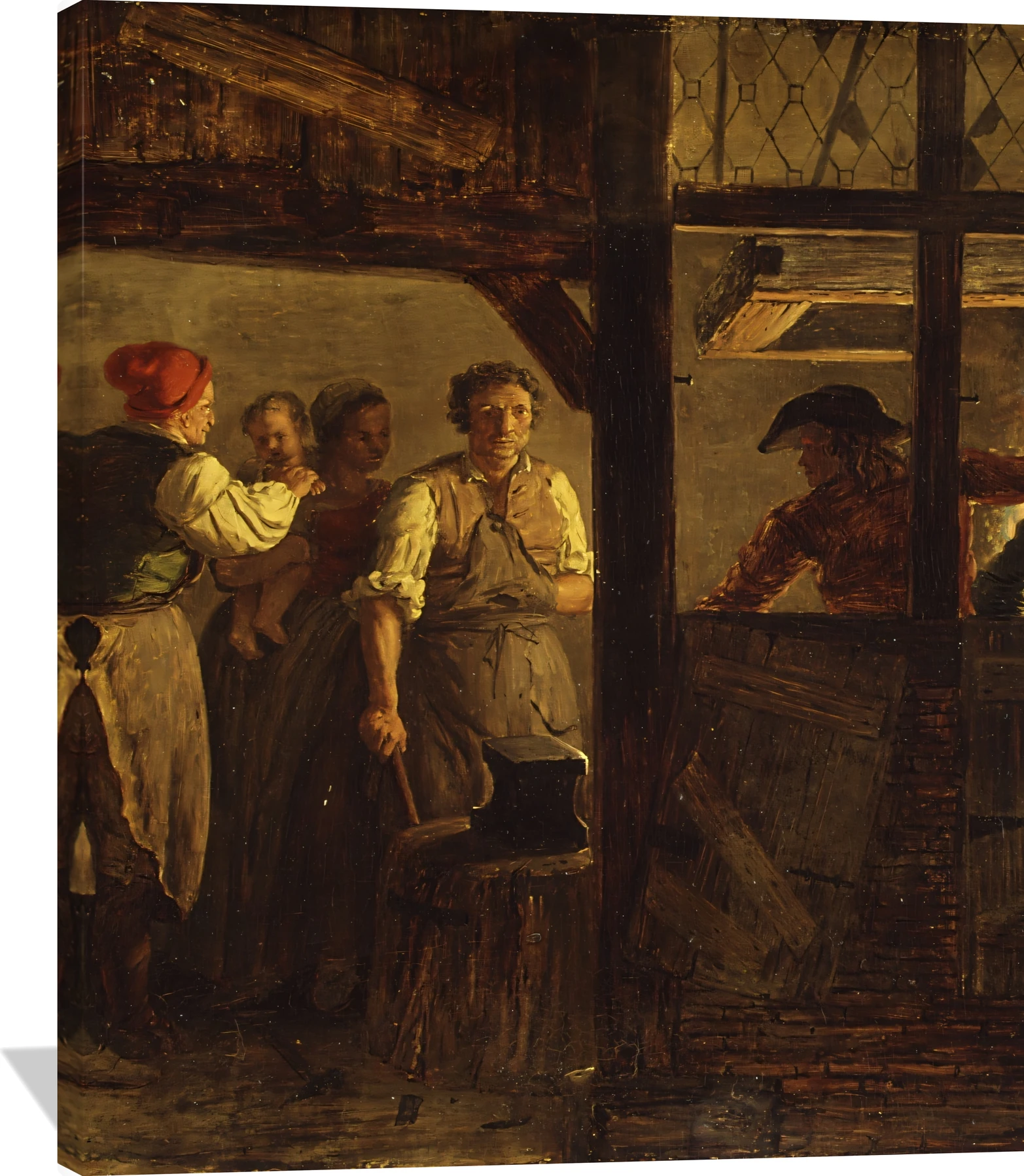
Léonard Defrance’s The Forge canvas captures the warmth and grit of 18th‑century craftsmanship. Bathed in golden browns, deep umbers, and soft amber light, the scene draws you into a rustic workshop where figures gather around the glowing heart of the forge. The painter’s masterful use of shadow and texture evokes both the heat of labor and the quiet dignity of daily life.
This timeless The Forge wall art brings depth and character to any space—ideal for a study, living room, or entryway. A museum‑quality canvas print that celebrates Flemish artistry and the enduring beauty of human industry.
Léonard Defrance (1735–1805) was a Flemish painter celebrated for his vivid portrayals of everyday life and early industrial settings. Active in the region of Liège, his work reflects the cultural and economic transformations of the late eighteenth century, capturing moments of labor, domesticity, and social interaction with striking clarity.
Artistic Style
Defrance is known for a refined yet approachable style that blends the precision of Flemish tradition with the emerging sensibilities of the Enlightenment. His mastery of light and spatial organization gives his compositions a sense of immediacy, while his attentive brushwork reveals the textures and details of ordinary environments. The mood in his scenes often balances warmth with realism, offering a window into daily life without embellishment.
Notable Subjects
He frequently depicted workshops, kitchens, and bustling interiors, making him one of the earliest European artists to paint industrial and proto-industrial spaces. These works provide an invaluable record of Europe’s shift toward mechanized production. Defrance also created landscapes, market scenes, and depictions of public festivities, each rendered with the same observational rigor that characterizes his more intimate compositions.
Cultural Significance
As one of the first professors at the newly founded Academy of Liège, Defrance played a formative role in shaping artistic education in the region. His paintings serve as historical documents of social and technological change, offering rare insight into the rhythms of eighteenth-century urban and artisanal life. Today, his work stands out for its remarkable authenticity and its contribution to the visual culture of the early industrial era.
What Makes His Work Distinctive
Defrance’s ability to render both human activity and architectural detail with equal sensitivity gives his compositions a uniquely immersive quality. His scenes capture the quiet dignity of labor and the unfolding narrative of daily routines, preserving moments of transition in a rapidly evolving society. His legacy endures as a testament to the power of art to document, observe, and illuminate the world in transformation.