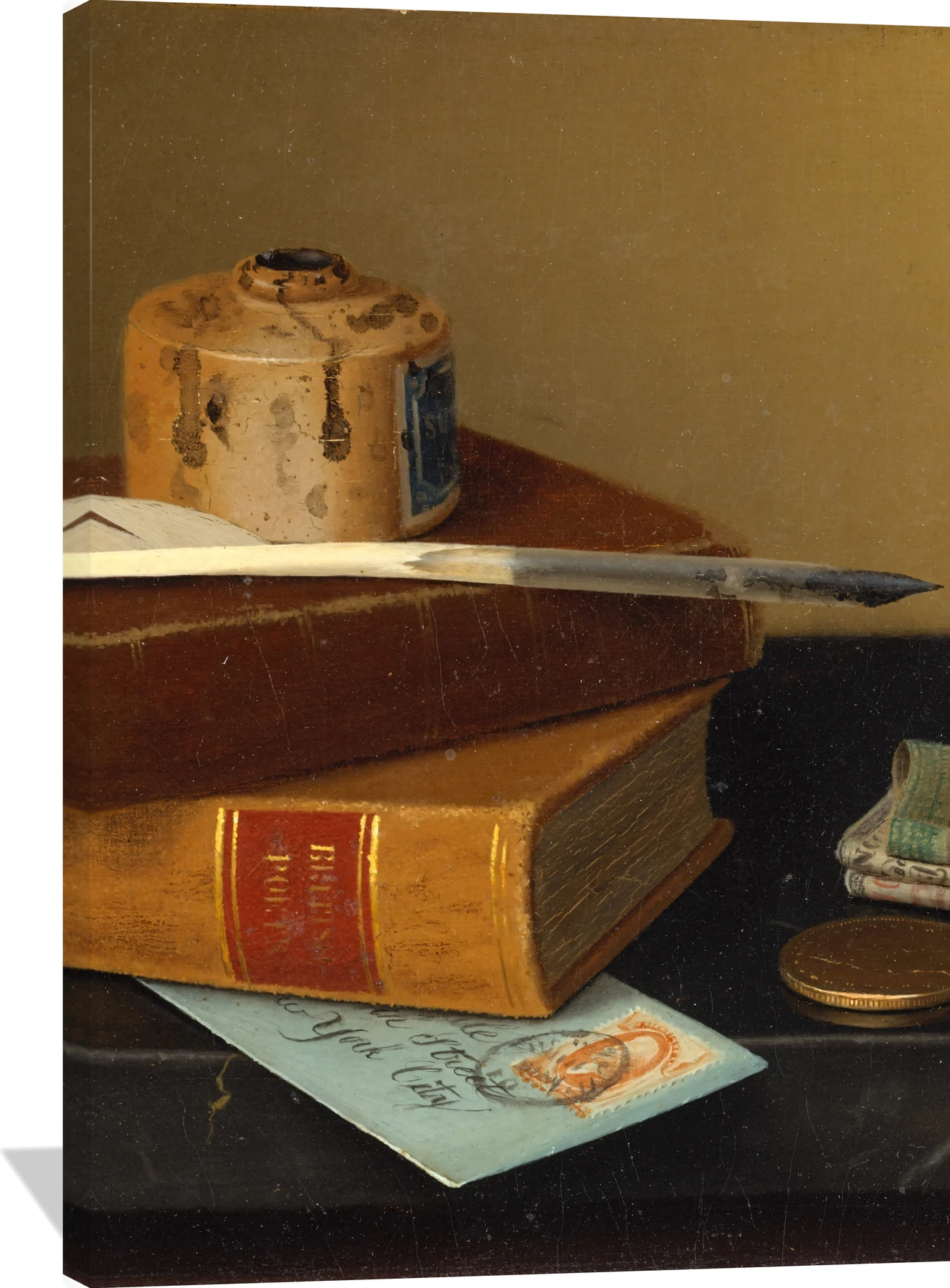
The William Michael Harnett The Banker’s Table canvas captures the quiet elegance of 19th-century realism. With meticulous detail, Harnett arranges books, coins, and a quill upon a dark marble surface, evoking themes of intellect and commerce. Warm tones of gold, brown, and ivory contrast beautifully against the deep blacks and subtle grays, creating a refined balance of light and shadow.
This timeless wall art brings sophistication and depth to any space. Ideal for a study, office, or classic living room, this canvas print invites viewers to pause and appreciate the artistry of everyday objects rendered with masterful precision.
William Michael Harnett (1848–1892) was a pioneering American painter celebrated for his extraordinarily precise still-life compositions and his influential role in advancing trompe-l’oeil realism in the late nineteenth century.
Artistic Style
Harnett became renowned for a meticulous, illusionistic technique that made everyday objects appear strikingly lifelike. His controlled use of shadow, texture, and spatial depth created visual puzzles that invited viewers to question what was painted and what was real. This commitment to exacting realism helped establish him as one of the most distinctive figures in American still-life painting.
Signature Subjects
He is best known for arrangements featuring worn books, musical instruments, tobacco pipes, currency, and utilitarian objects rendered with remarkable clarity. Works such as The Old Violin exemplify his ability to transform humble belongings into richly evocative scenes that celebrate craftsmanship, time, and material presence.
Cultural Significance
Harnett’s paintings resonated with a rapidly modernizing United States, offering a contemplative counterpoint to industrial progress while also demonstrating a sophisticated visual wit. His compositions influenced a generation of artists and helped popularize trompe-l’oeil painting across America. Today, his work remains admired for its technical brilliance, subtle symbolism, and its enduring contribution to the narrative of American realism.