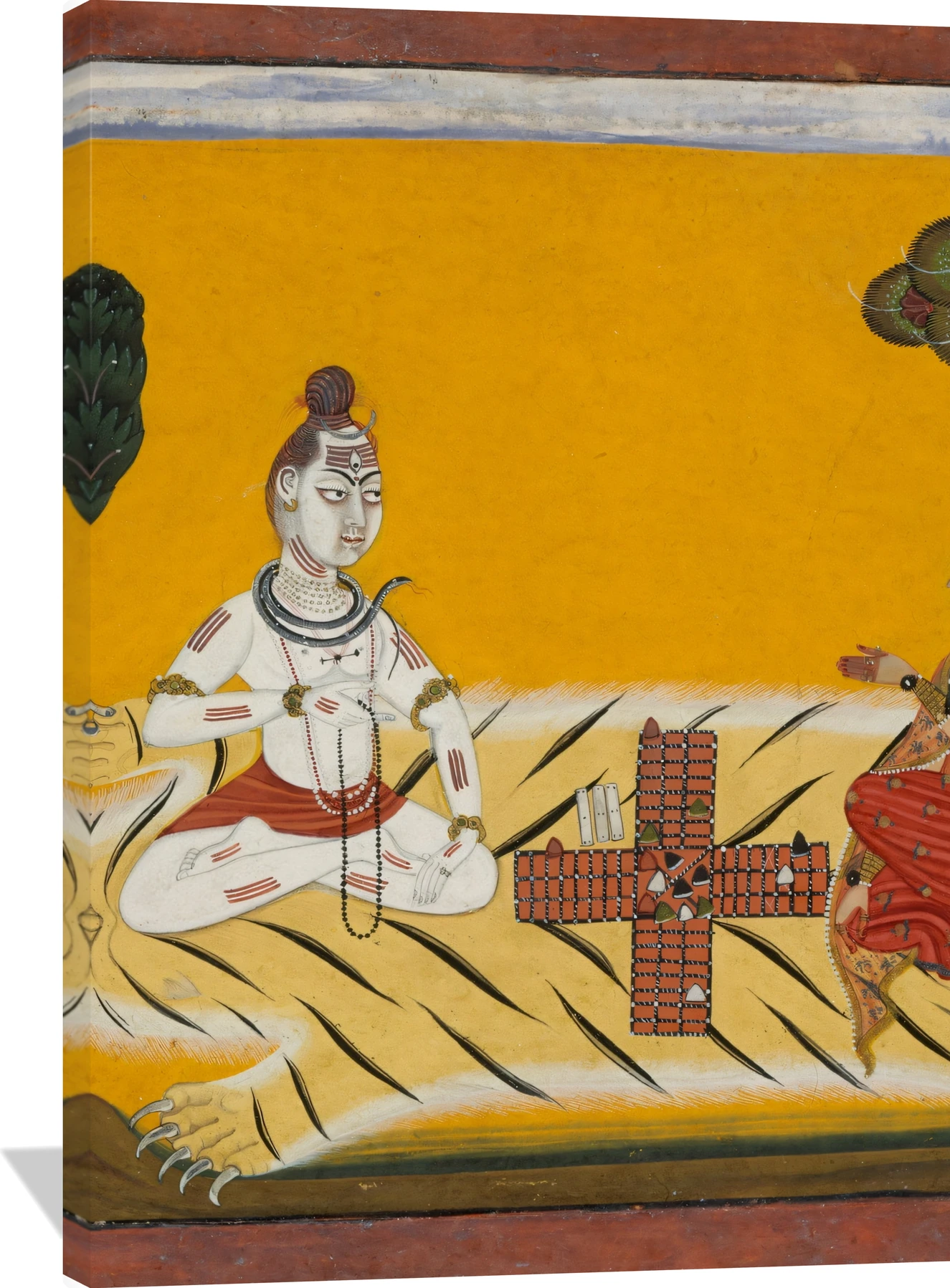
The Devidasa of Nurpur Shiva and Parvati Playing Chaupar: Folio from a Rasamanjari Series canvas captures a serene divine moment rendered in luminous hues of saffron yellow, deep green, ivory, and crimson. The composition’s refined lines and balanced symmetry evoke the contemplative grace of 17th-century Pahari miniature art, inviting a sense of spiritual harmony into any space.
This exquisite wall art brings timeless elegance to modern interiors—perfect for a living room, study, or entryway. Each canvas print celebrates Devidasa of Nurpur’s mastery, transforming sacred storytelling into a radiant focal point that blends history, devotion, and artistry with effortless sophistication.
Devidasa of Nurpur, active circa 1680–1720, stands among the most distinctive painters of the northern Indian Pahari tradition. Working within the Nurpur court ateliers, he helped shape a lyrical visual language marked by expressive linework, jewel-like color, and an intimate sense of atmosphere.
Artistic Style
Devidasa’s paintings are recognized for their elegant contours, finely modulated hues, and a characteristic balance between emotional intensity and refined restraint. His compositions often highlight delicate facial modeling, rhythmic drapery, and landscapes that fuse stylized forms with subtle naturalism. These qualities became emblematic of the Nurpur school’s emerging aesthetic and played a pivotal role in defining its identity.
Subjects and Themes
Working primarily on illustrated manuscripts and independent miniatures, Devidasa depicted episodes from devotional literature, especially narratives related to Krishna, Rama, and regional poetic traditions. Scenes of courtly life and romantic encounters also appear in his oeuvre, rendered with a sensitivity that reveals his strong command of gesture and expression.
Legacy and Significance
Though documentation of his life is limited, Devidasa’s surviving works position him as a key figure in the evolution of Pahari painting. His artistic voice helped bridge earlier regional styles with a more expressive, narrative-rich idiom. Today, collectors and scholars value his paintings for their refinement, historical resonance, and the way they exemplify the **distinctive elegance** of the Nurpur school.