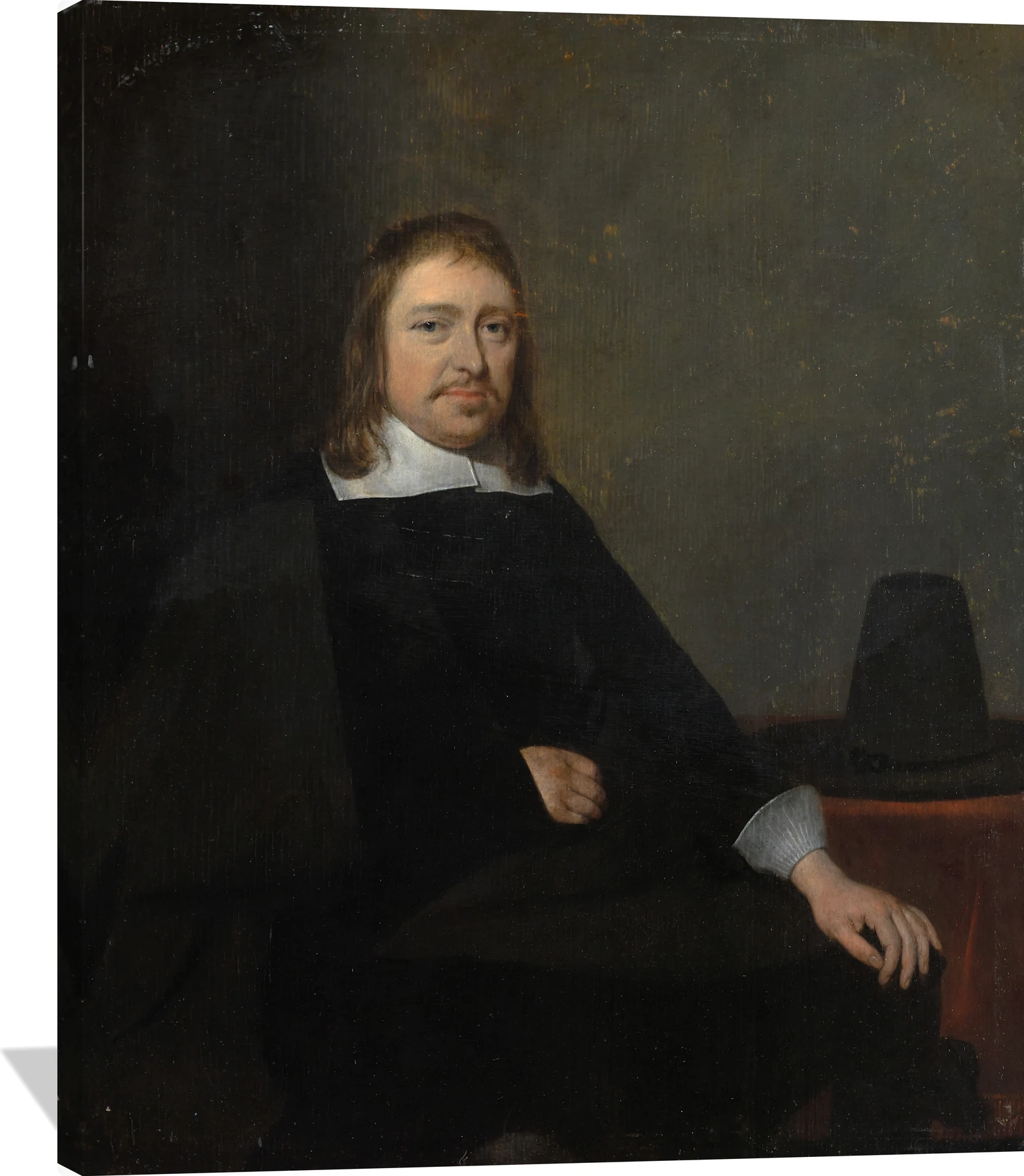
The Gerard ter Borch the Younger Portrait of a Seated Man canvas captures the quiet dignity and refined realism of the Dutch Golden Age. Rendered in warm earth tones, deep blacks, and soft grays with subtle highlights of ivory and muted red, this timeless composition exudes calm authority and introspection. The sitter’s poised expression and elegant attire reflect Ter Borch’s mastery of texture and light.
This exquisite wall art brings a sense of heritage and sophistication to any setting—perfect for a study, library, or classic living space. A museum-quality canvas print that celebrates the enduring artistry of Gerard ter Borch the Younger, Dutch, Zwolle 1617–1681 Deventer.
Gerard ter Borch the Younger (Dutch, Zwolle 1617–1681 Deventer) was a master of quiet refinement, celebrated for his ability to elevate everyday moments into scenes of extraordinary psychological depth. Active during the Dutch Golden Age, he became renowned for his intimate interior settings, nuanced character studies, and unmatched skill in depicting luxurious fabrics.
Artistic Style and Technique
Ter Borch’s signature style rests in his subtle handling of light and his precise, sensitive brushwork. His depictions of satin a hallmark of his oeuvre demonstrate his extraordinary eye for texture and reflectivity. Rather than presenting grand narratives, he focused on understated, contemplative moments, creating works that feel both immediate and timeless.
Subjects and Themes
He gravitated toward domestic interiors, refined social exchanges, and elegant figure studies. Many of his paintings capture the quiet tension of interpersonal relationships, rendered through posture, gesture, and gaze rather than overt drama. This attention to emotional nuance helped shape the development of genre painting in the Netherlands.
Legacy and Significance
Ter Borch’s work stands at the intersection of realism and psychological subtlety. His influence can be seen in later Dutch genre painters, who drew inspiration from his intimate settings and atmospheric restraint. Today, he is remembered as a leading figure of the era whose paintings continue to captivate with their quiet sophistication, refined technique, and enduring emotional resonance.