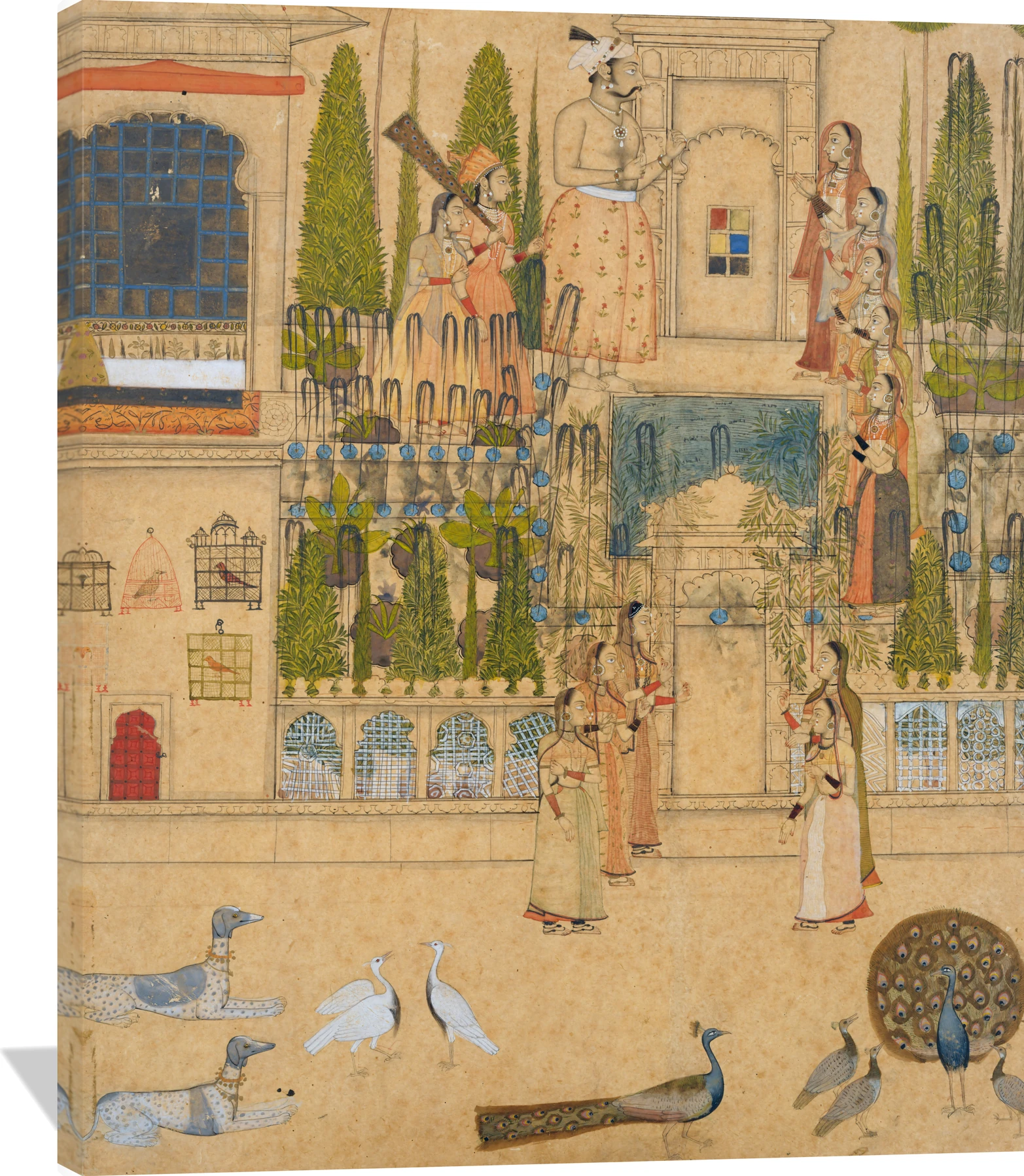
The Stipple Master Maharana Amar Singh II with Ladies of the Zenana outside the Picture Hall at Rajnagar canvas captures a regal moment of serene elegance and courtly grace. Rendered in delicate hues of gold, sage green, indigo, and soft coral, this intricate composition reflects the refined artistry of late 17th-century India. The scene’s architectural detail and lush garden setting evoke a timeless sense of harmony and sophistication.
This exquisite wall art brings historical grandeur and cultural depth to any interior. Ideal for a living room, study, or entryway, this museum-inspired canvas print invites conversation and admiration while celebrating the enduring beauty of Indian miniature painting.
The artist known as Stipple Master, active in India between 1690 and 1715, is celebrated for his refined command of the stipple technique and his contribution to the evolution of early modern South Asian draftsmanship. Although his personal identity remains uncertain, surviving works and stylistic evidence highlight an accomplished hand deeply attuned to the visual culture of the late Mughal period.
Artistic Style
Stipple Master’s work is distinguished by delicate dotting that produces subtle gradients, creating a soft shimmer unusual for the era. This approach allowed him to achieve remarkable tonal precision, lending his figures and decorative motifs a quiet luminosity. His drawings often display a balance between disciplined linework and rhythmic ornamentation, exemplifying the period’s shift toward heightened naturalism.
Subjects and Themes
Typical subjects include courtly portraits, botanical studies, and scenes of refined leisure. His renderings of flora, occasionally presented in albums or as standalone sheets, demonstrate meticulous observation and a sensitivity to organic form. Portraits attributed to him often feature noble sitters, their garments and jewelry interpreted with an almost meditative attention to detail. A number of works, such as the attributed Portrait of a Court Musician, showcase his ability to merge lifelike presence with stylized elegance.
Historical and Cultural Significance
Working during a period of intense artistic exchange, Stipple Master absorbed influences circulating through Mughal ateliers while contributing his own innovations in texture and shading. His output reflects an environment where Persianate traditions intersected with growing interests in natural history and empirical observation. Scholars regard him as part of the generation that helped transition Indian draftsmanship toward greater tonal variation, a development of lasting technical importance.
Legacy
Although few works can be firmly attributed, the finesse of his stippling and the quiet sophistication of his compositions have secured his place among the distinctive illustrators of his time. Collectors and historians value his sheets for their blend of artistic precision and poetic restraint, qualities that continue to resonate with today’s admirers of South Asian art. His surviving oeuvre stands as a testament to the creativity and subtle innovation that marked the late Mughal artistic world, leaving a notable imprint on subsequent generations of painters and draftsmen.