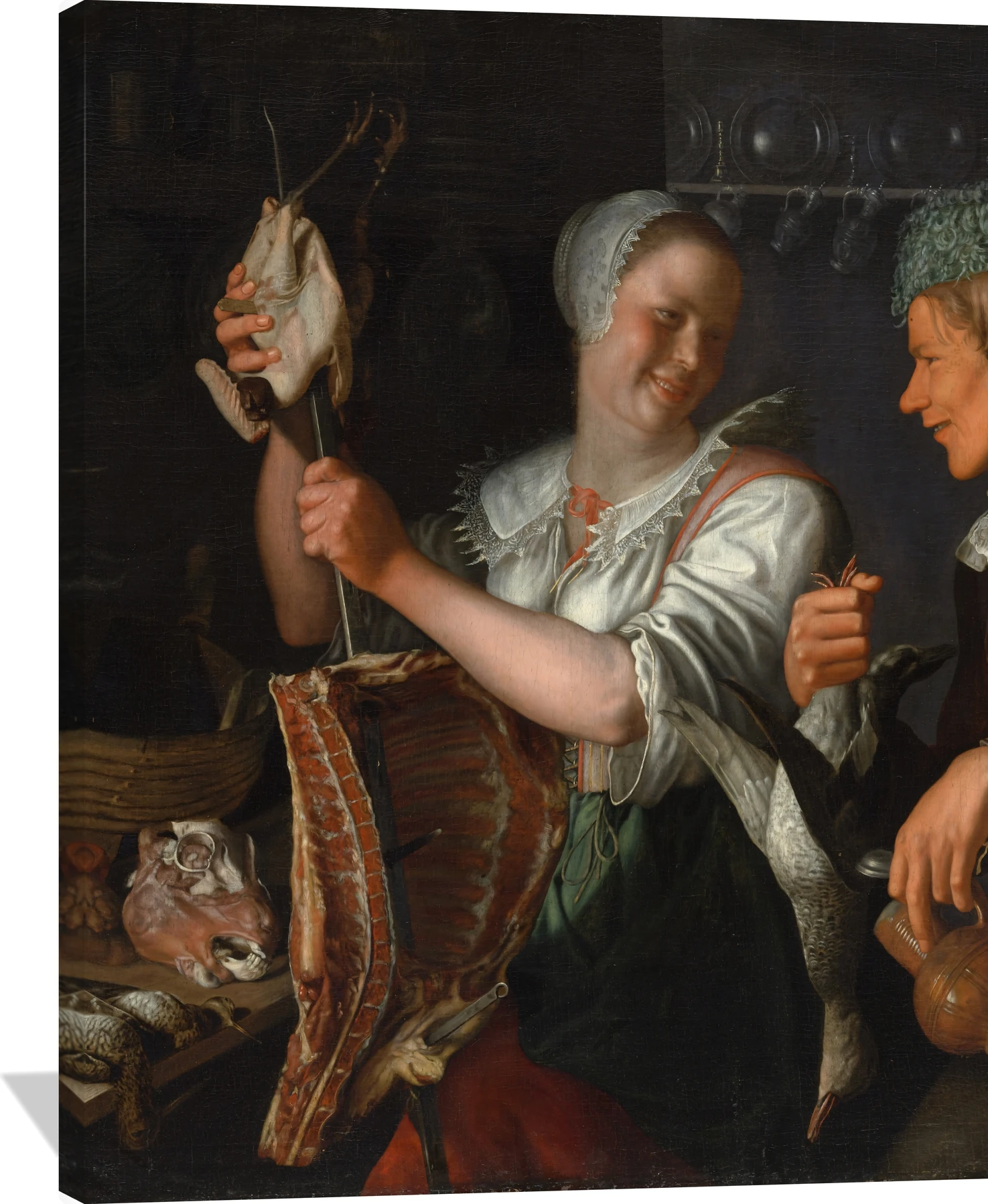
The Peter Wtewael Kitchen Scene canvas captures the lively warmth of a 17th-century Dutch kitchen, where everyday life unfolds with humor and intimacy. Rich tones of deep brown, warm ochre, and soft ivory bring texture to the rustic setting, while the artist’s masterful play of light highlights the figures’ expressive faces and the abundance of food around them.
This exquisite wall art evokes the charm of the Dutch Golden Age, making it an ideal centerpiece for a dining room, study, or entryway. A canvas print that celebrates craftsmanship and conviviality, it invites viewers to savor the beauty of simple moments rendered with timeless elegance.
Peter Wtewael (1596–1660), a Dutch painter from Utrecht, was part of a distinguished artistic family and inherited the vibrant visual language of the Utrecht Caravaggisti. Working in the early seventeenth century, he developed a refined approach that blended the bold naturalism of Caravaggio with the luminous color and elegance characteristic of Northern Mannerism.
Artistic Style
Wtewael’s paintings are known for their vivid palette, polished surfaces, and carefully orchestrated compositions. He often explored complex spatial arrangements and expressive figural poses, creating works that balance dramatic narrative with a sense of courtly grace. His style reveals a sophisticated understanding of light and texture, bringing vitality to scenes drawn from mythology, religion, and everyday life.
Subjects and Themes
His subjects range from intimate genre scenes to mythological allegories, frequently infused with subtle wit and symbolic detail. Wtewael’s interest in human expression and gesture lends emotional nuance to his work, while his attentive rendering of fabric, skin, and still-life elements underscores his technical mastery. When depicting stories from antiquity, he transformed familiar tales into visually sumptuous tableaux, elevating them with a distinctive sense of theatricality.
Legacy and Significance
As a prominent figure in Utrecht’s artistic milieu, Peter Wtewael contributed to the evolution of Dutch painting during a period of stylistic transition. His ability to merge the dramatic innovations of Caravaggism with the ornamental qualities of late Mannerism resulted in a body of work that remains admired for its richness and refinement. Today, Wtewael is recognized for maintaining the family’s artistic legacy while forging a voice uniquely his own.