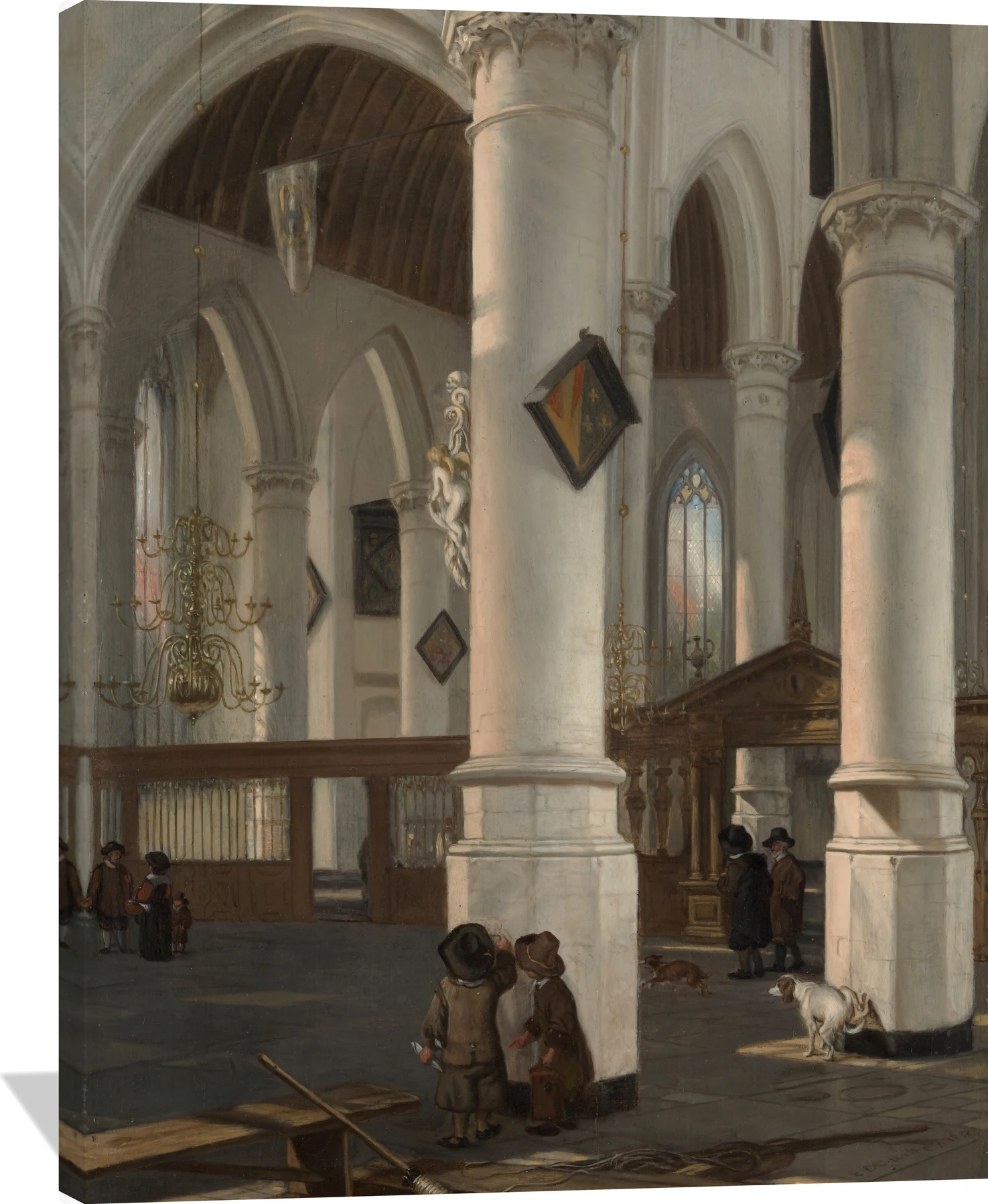
The Emanuel de Witte Interior of the Oude Kerk, Delft canvas captures the serene grandeur of a Dutch church bathed in soft daylight. With its soaring arches, luminous stone columns, and subtle interplay of shadow and gold, this masterpiece evokes quiet reverence and timeless beauty. Warm neutrals, ivory whites, and muted browns create a harmonious palette that complements both classic and modern interiors.
This museum-quality canvas print brings depth and sophistication to any space. Ideal for a living room, study, or entryway, the Interior of the Oude Kerk, Delft wall art invites reflection and calm, celebrating the artistry and perspective of one of the Dutch Golden Age’s finest painters.
Emanuel de Witte (Dutch, Alkmaar ca. 1616–1692 Amsterdam) was a master of atmospheric interior scenes whose meticulous handling of space, light, and perspective set him apart within the Dutch Golden Age.
Artistic Focus and Style
De Witte is best known for his evocative depictions of church interiors, domestic spaces, and architectural vistas. His paintings reveal a finely tuned sensitivity to shifting light, subtle tonal gradients, and the interplay between structure and shadow. Rather than emphasizing precise architectural transcription alone, he pursued a mood-driven realism, creating immersive environments that draw viewers into quiet, contemplative moments.
Subjects and Techniques
Typical subjects include expansive Gothic and Protestant church interiors, illuminated by natural light filtering through high windows. De Witte often incorporated everyday figures, dogs, or simple still-life elements to infuse grandeur with human presence. His fluid brushwork and command of perspective allowed him to balance architectural complexity with a serene, grounded atmosphere. Works such as Interior of a Church exemplify his ability to orchestrate depth and luminosity with exceptional harmony.
Cultural and Historical Significance
As part of the vibrant 17th-century Dutch art scene, De Witte contributed a distinctive vision that diverged from contemporaries focused on rigid architectural accuracy. His emotionally resonant spaces helped shape the tradition of interior painting, influencing later generations drawn to spatial drama and nuanced light. Today, his work remains celebrated for its refinement, sensitivity, and its enduring atmospheric depth, distinguishing him as one of the most compelling interpreters of space in Dutch Golden Age painting.