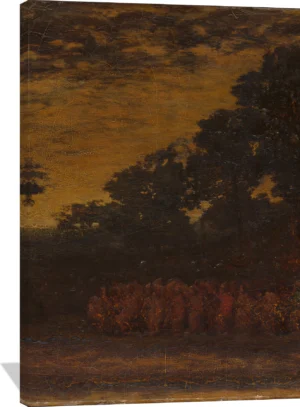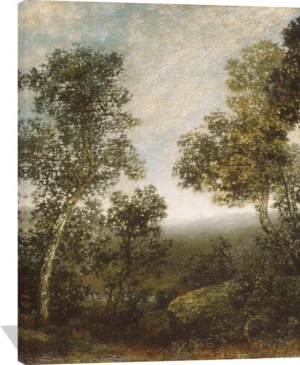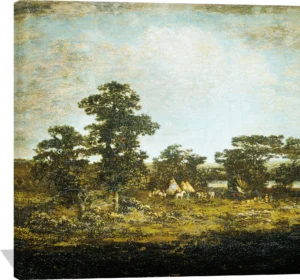
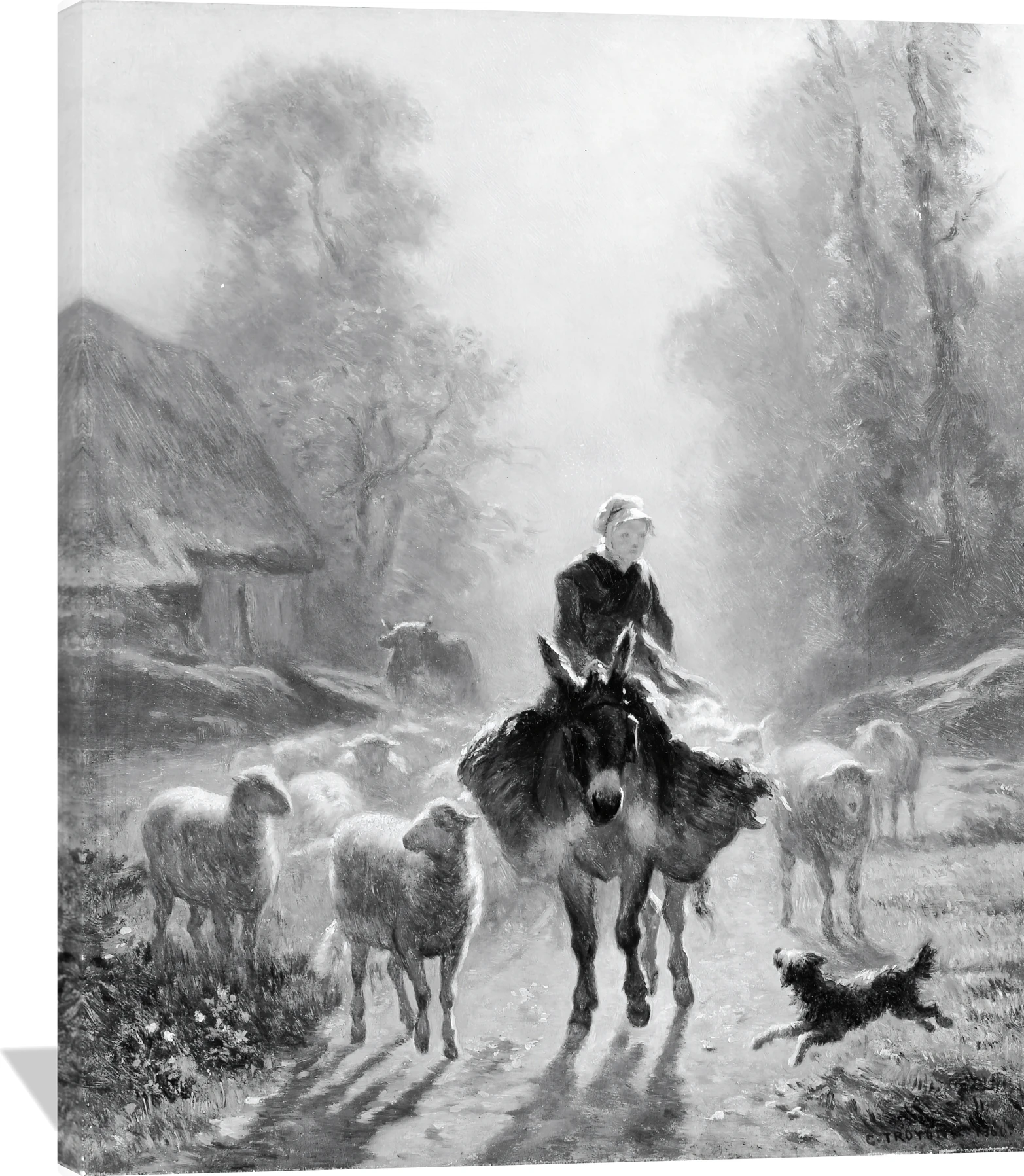
The Constant Troyon Going to Market canvas captures a tranquil rural morning bathed in soft light. A woman on a donkey leads her flock along a country path, framed by tall trees and rustic cottages. Earthy tones of warm browns, muted greens, and silvery grays evoke the calm rhythm of pastoral life, rendered with Troyon’s signature realism and gentle luminosity.
This timeless canvas print brings a sense of serenity and tradition to any space. Ideal for a living room, study, or entryway, it invites quiet reflection and a touch of 19th‑century French charm into your home décor.
Constant Troyon (1810–1865) was a distinguished French painter associated with the Barbizon School, celebrated for his evocative landscapes and masterful animal subjects. Born in Sèvres and trained within the artistic circles surrounding the Sèvres porcelain factory, he developed a deep sensitivity to natural light, atmospheric nuance, and the rustic rhythms of rural life.
Artistic Style
Troyon’s style blends the poetic naturalism of the Barbizon movement with a keen observational eye. His paintings often feature expansive skies, soft tonal transitions, and a grounded sense of realism that reflects his careful study of the French countryside. Equally known for his dynamic animal depictions, he elevated pastoral scenes through his confident brushwork and expressive modeling of form.
Notable Contributions
While Troyon began his career primarily as a landscape painter, his travels to the Netherlands in the 1840s profoundly shaped his direction. Inspired by the Dutch masters, he honed a specialty in portraying cattle and working animals with remarkable vitality. His ability to merge landscape and animal painting into a unified, harmonious vision became one of his most celebrated achievements and secured his place among the foremost animal painters of his era.
Subjects and Significance
Troyon’s canvases typically highlight pastoral life, grazing herds, and the serene yet hardworking atmosphere of rural France. His work captures an era of transition, preserving the authenticity of agrarian culture on the brink of modernization. As part of the Barbizon School, he contributed meaningfully to the shift toward naturalistic, plein-air painting that later influenced Impressionism.
Legacy
Admired for his refined technique and deep connection to the land, Troyon left a lasting imprint on 19th‑century French art. His paintings, whether pure landscapes or richly characterized animal scenes, remain sought after for their balance of tranquility and expressive detail. Today, his legacy endures through his status as a leading figure in the Barbizon movement and a master of the naturalist pastoral tradition.