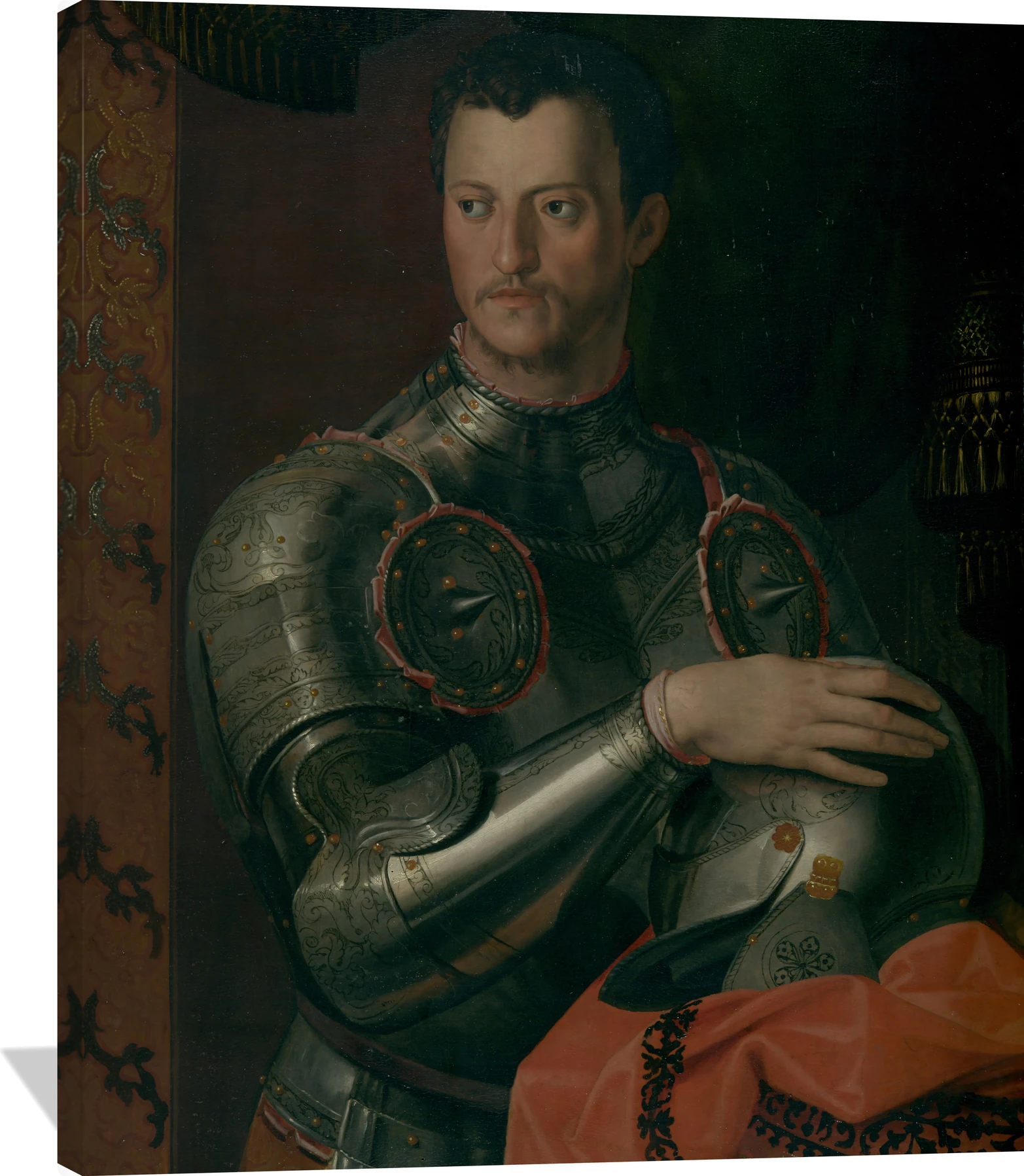
The Bronzino Cosimo I de’ Medici canvas captures the commanding presence of the Florentine ruler in gleaming armor, rendered with exquisite precision and cool Renaissance poise. Deep tones of steel gray, crimson, and gold contrast against a dark, velvety backdrop, evoking both strength and refinement in every detail.
This museum-quality wall art brings timeless sophistication to any interior—perfect for a study, library, or elegant living space. A canvas print of Bronzino’s masterful portrait adds a touch of Italian grandeur, celebrating power, artistry, and the enduring beauty of Renaissance portraiture.
Bronzino (Agnolo di Cosimo), born in Monticelli in 1503 and active in Florence until his death in 1572, was a central figure of the Florentine Mannerist school. Celebrated for his refined technique and aristocratic elegance, he became one of the most sought‑after portraitists of the Italian Renaissance.
Artistic Style
Bronzino’s work is distinguished by its meticulous precision, cool tonality, and polished surfaces. His mastery of line and form gives his figures a serene, almost sculptural presence. This highly controlled aesthetic, marked by subtle emotional restraint, became a hallmark of Florentine Mannerism and contributed to his reputation as a painter of exceptional finesse.
Notable Contributions
As the official court painter to the Medici, Bronzino created some of the era’s most iconic portraits. His depictions of Cosimo I de’ Medici and Eleonora di Toledo set new standards for courtly representation, blending visual grandeur with intimate detail. His altarpieces and allegorical scenes, including works such as Allegory with Venus and Cupid, reveal his ability to merge intellectual complexity with visual harmony, a defining characteristic of his art.
Typical Subjects
Bronzino primarily focused on portraits, religious compositions, and allegorical narratives. His portraiture captures sitters with striking clarity, emphasizing nobility, poise, and exquisite costume detail. In his religious paintings, elongated forms and idealized beauty enhance the spiritual atmosphere, while his allegories showcase his skill in blending symbolic meaning with elegant visual design.
Cultural and Historical Significance
As a leading figure of Florentine culture during the height of Medici influence, Bronzino shaped the visual identity of Renaissance court life. His portraits not only document historical figures but also exemplify the aesthetics and intellectual aspirations of their time. His influence extended to younger artists, and his precise, courtly style remains admired for its balance of technical mastery and artistic sophistication.
Bronzino’s legacy endures through his role in defining the refined, polished elegance of Mannerism, a style that continues to captivate viewers with its timeless sophistication and unmistakable grace.