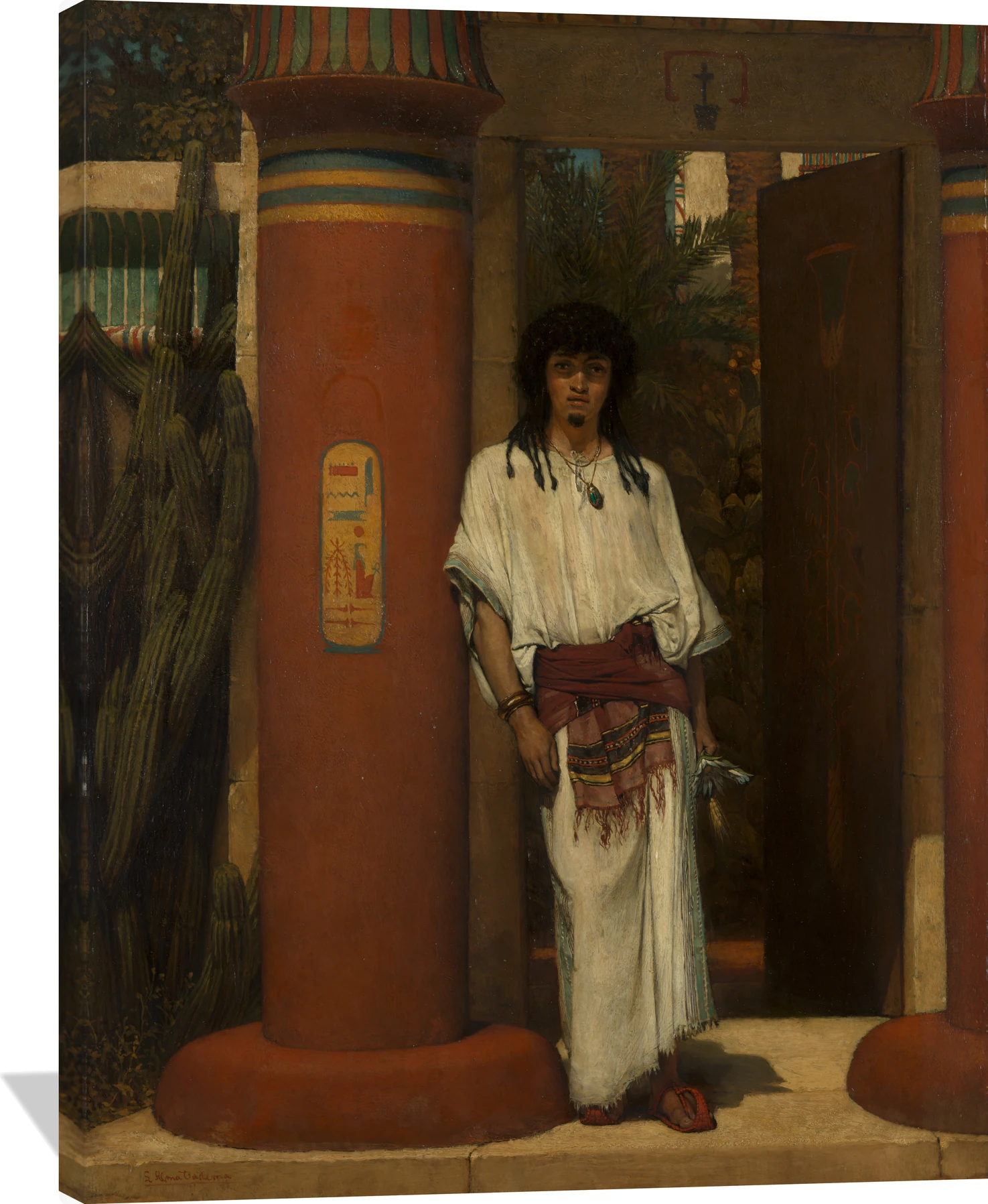
The Sir Lawrence Alma-Tadema An Egyptian in a Doorway canvas captures a moment of quiet poise and timeless elegance. Rendered in warm terracotta, ivory, and deep green tones, the painting depicts a serene figure framed by grand Egyptian columns, bathed in soft, golden light. Alma-Tadema’s meticulous detail and classical realism evoke both mystery and grace, inviting contemplation of ancient worlds and human presence within them.
This museum-quality canvas print brings refined sophistication to any space. Ideal for a living room, study, or entryway, the An Egyptian in a Doorway wall art adds a touch of historic beauty and cultured calm to modern interiors.
Sir Lawrence Alma-Tadema (1836–1912) was a British painter born in Dronrijp, the Netherlands, celebrated for his exquisitely detailed visions of the ancient world. After establishing his early career on the Continent, he settled in England, where his mastery of historical genre painting made him one of the most sought-after artists of the Victorian era.
Artistic Style
Alma-Tadema is renowned for his meticulous archaeological accuracy and luminous, marble-filled compositions. His work blends academic precision with an atmospheric softness, creating scenes that feel both scholarly and sensuous. His palette is marked by radiant light, intricate textures, and the delicate rendering of materials such as stone, fabric, and flowers.
Themes and Subjects
His paintings often depict daily life in ancient Rome, Greece, and Egypt, portraying intimate domestic moments, ceremonial gatherings, and serene architectural vistas. With an almost cinematic attention to detail, Alma-Tadema infused classical settings with human warmth and narrative richness. Works like The Roses of Heliogabalus exemplify his ability to transform historical motifs into emotionally evocative tableaux.
Legacy and Significance
Alma-Tadema’s influence extended far beyond the Victorian period. His vivid reconstruction of antiquity informed later visual culture, inspiring set designers, filmmakers, and generations of historical painters. Admired for his unparalleled technical finesse and his evocative reimagining of ancient life, he remains a defining figure of nineteenth-century academic art.