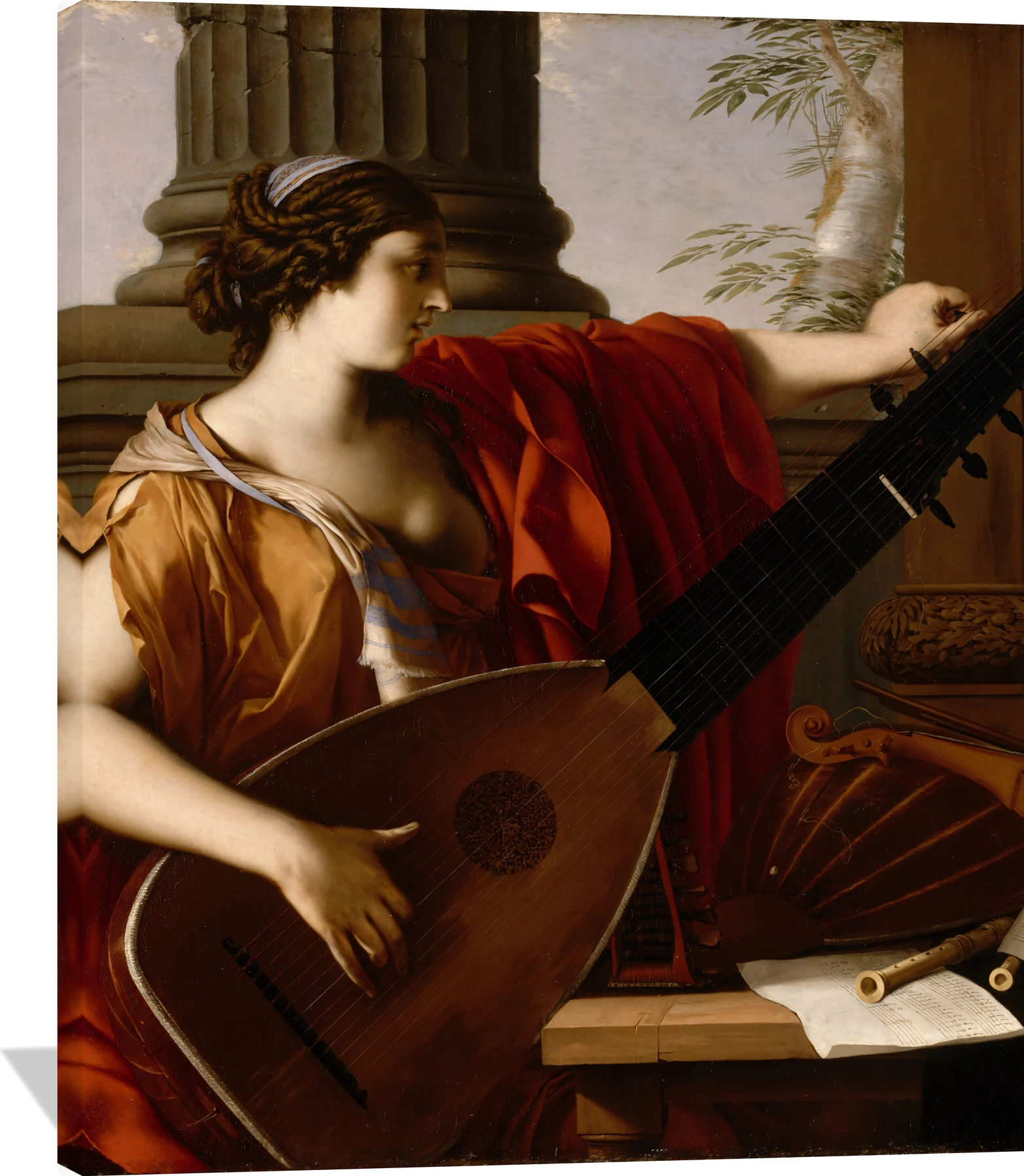
The Laurent de La Hyre Allegory of Music canvas captures the serene harmony of art and intellect through a luminous portrayal of a musician tuning her instrument. Warm amber, crimson, and soft ivory tones glow against classical architectural columns, evoking the refined grace of 17th‑century Parisian artistry. Every detail—from the gentle drape of fabric to the scattered sheet music—reflects a quiet devotion to beauty and balance.
This museum‑quality Allegory of Music wall art brings timeless sophistication to your living room, study, or entryway. A masterful blend of stillness and rhythm, it invites reflection and elegance into any interior space.
Laurent de La Hyre (1606–1656) was a prominent French painter of the early 17th century, active in Paris during the formative years of the French Baroque. Celebrated for his refined classicism, he played a central role in shaping the visual language that would later define the French academic tradition.
Artistic Style
La Hyre’s work is distinguished by its serene compositions, luminous palette, and exceptional clarity of form. His approach balanced the emotional resonance of the Baroque with a measured restraint, resulting in paintings that feel both harmonious and contemplative. Figures are rendered with graceful precision, and his architectural settings demonstrate a meticulous command of perspective.
Notable Contributions
A founding member of the Académie Royale de Peinture et de Sculpture, La Hyre helped guide French painting toward a more idealized and intellectual mode. His contributions to history painting and allegorical subjects marked him as a key voice in the transition between late Mannerism and the emerging classical style that would come to define the reign of Louis XIV.
Subjects and Themes
His oeuvre includes mythological scenes, biblical narratives, allegories, and portraits. Works such as The Judgement of Paris and Allegory of Music reveal his long-standing interest in harmony, moral clarity, and the expressive potential of the human figure. Even in complex narratives, La Hyre favored balanced compositions that guide the viewer’s eye with deliberate elegance.
Cultural Significance
La Hyre’s legacy lies in his ability to synthesize classical ideals with the subtle emotional depth of the Baroque. His paintings embody a vision of order and beauty that became foundational for generations of French artists. Today, he is recognized as a key figure whose work bridges innovation and tradition, offering collectors a window into the intellectual refinement of 17th-century Parisian art.