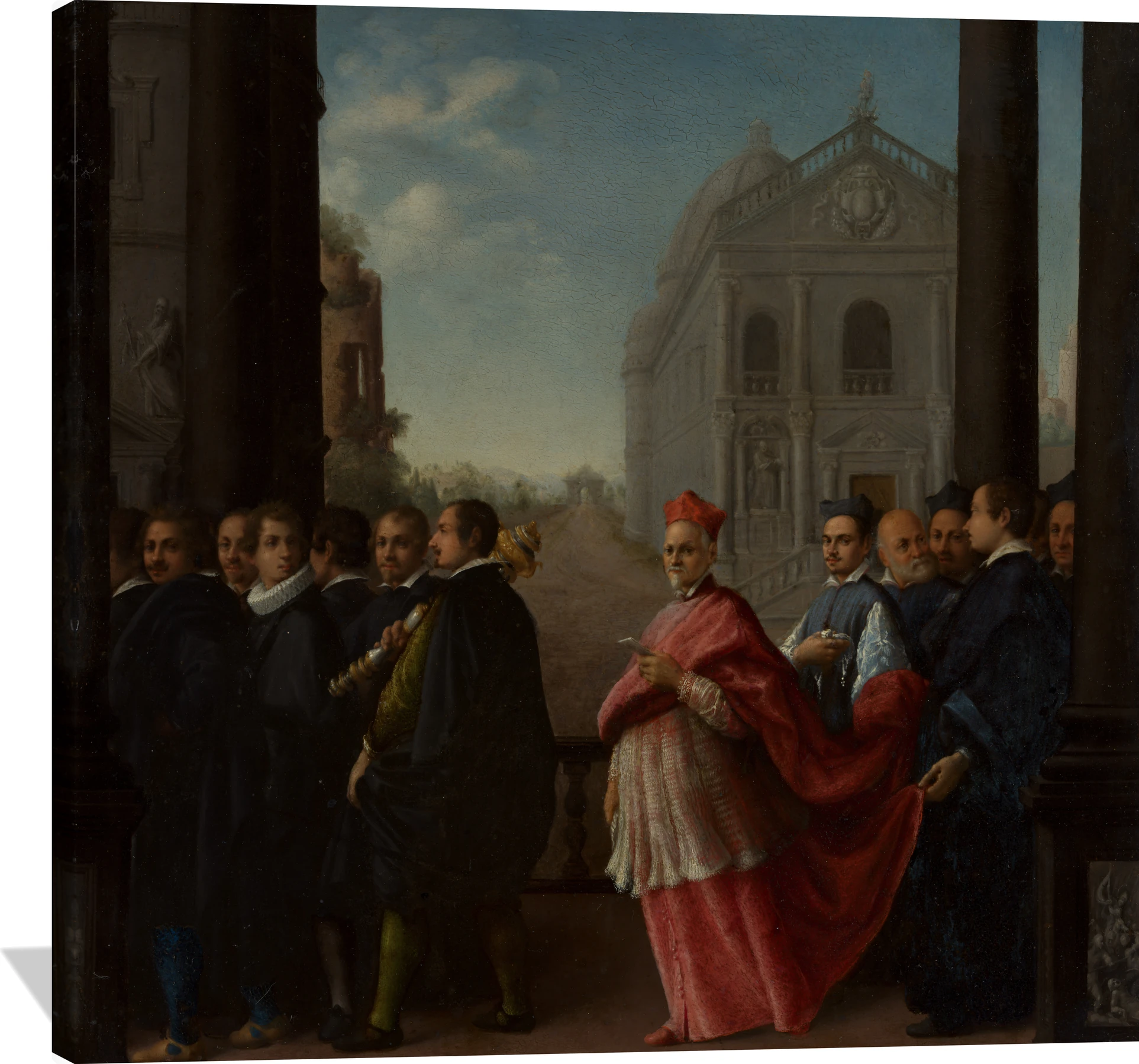
The Ottavio Leoni (Il Padovano) A Cardinal’s Procession canvas captures a moment of stately grace and quiet ceremony. In this refined composition, a cardinal robed in crimson leads a dignified entourage through a grand architectural setting bathed in soft light. Deep blues, warm reds, and muted golds balance against the pale stone of a Renaissance façade, creating a scene both solemn and luminous.
This exquisite wall art evokes the grandeur of 17th-century Rome, making it a striking focal point for a living room, study, or entryway. A masterful canvas print that brings timeless elegance and historical depth to contemporary interiors.
Ottavio Leoni, known as Il Padovano, was an influential Italian draftsman and painter active in Rome from 1578 to 1630. Renowned for his refined portraiture, he earned a distinguished place among the city’s most sought-after artists during the early Baroque period.
Artistic Style and Techniques
Leoni’s work is celebrated for its remarkable precision, subtle shading, and expressive clarity. His mastery of chalk drawing allowed him to capture the nuances of human features with exceptional sensitivity, creating portraits that feel both intimate and lifelike. His approach balanced the elegance of late Mannerism with the emerging naturalism of the Baroque, resulting in a distinctive visual language that emphasized character as much as likeness.
Subjects and Notable Contributions
Best known for his portrait drawings, Leoni produced vivid studies of Rome’s cultural and intellectual elite, including artists, scholars, and nobility. These works stand out not only for their technical finesse but also for their psychological depth. Through delicate lines and restrained tonal contrasts, he conveyed personality with striking immediacy. His surviving portrait series provides a valuable visual record of Rome’s creative community, making him a central figure in the city’s artistic documentation.
Cultural and Historical Significance
Leoni’s portraits constitute one of the most important archives of early seventeenth‑century Roman society. His ability to merge observational accuracy with a refined aesthetic helped set new standards for portrait drawing in his time. Collectors and historians continue to value his work for its honesty, elegance, and historical insight. As a result, Ottavio Leoni remains recognized for his exceptional draftsmanship and his role as a leading portraitist at a pivotal moment in Italian art.