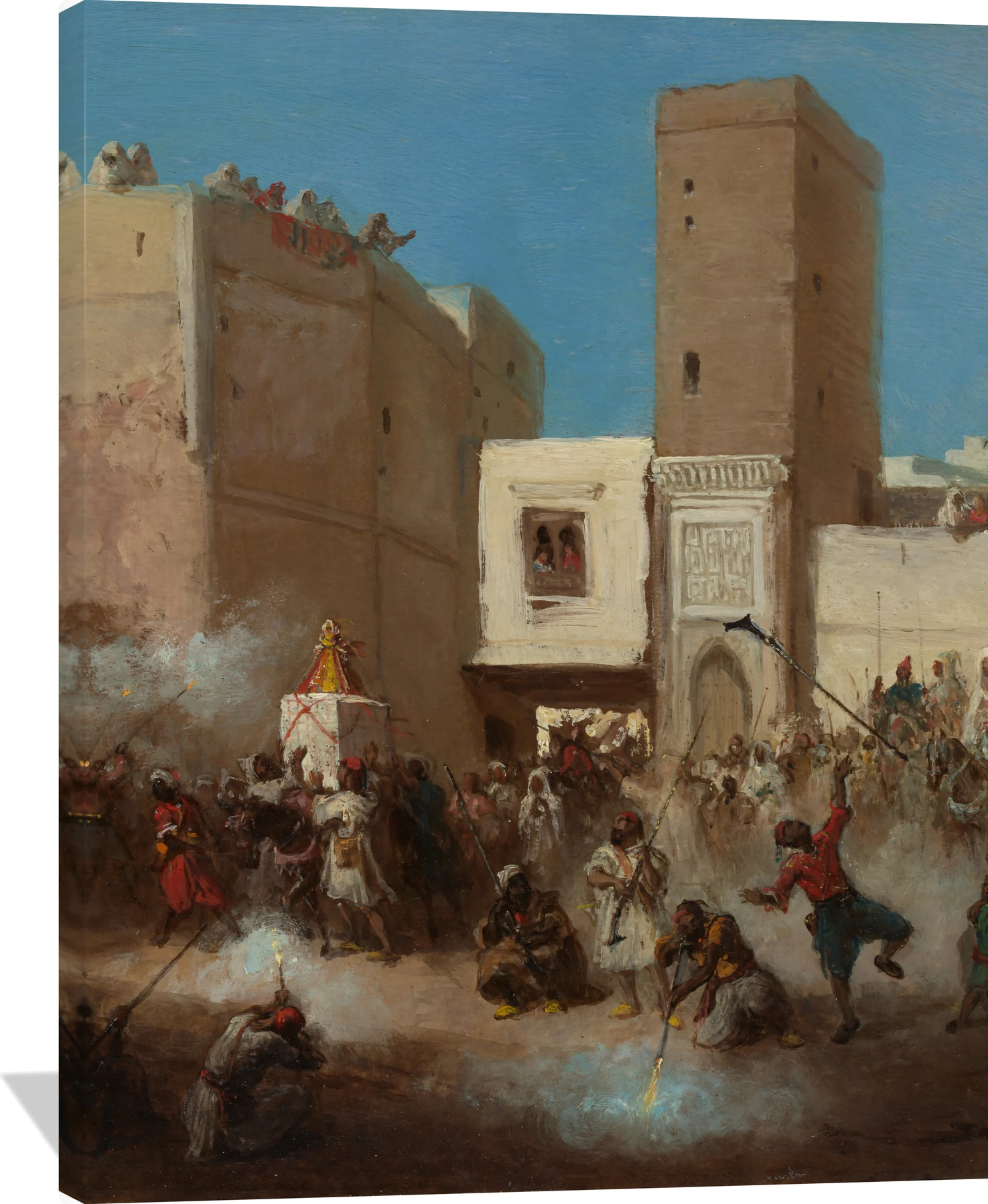
The Victor Eeckhout Wedding Procession canvas captures the vibrant energy of a festive street scene set against sunlit ochre walls and a brilliant blue sky. Eeckhout’s masterful brushwork and warm palette of sandy beige, crimson, and muted teal evoke the rhythm and color of North African life, immersing viewers in a moment of cultural celebration and movement.
This finely detailed canvas print brings a sense of history and vitality to any space. Ideal for a living room, study, or entryway, it adds both sophistication and storytelling to your decor—an evocative piece that celebrates the artistry of a Belgian painter inspired by his travels.
Victor Eeckhout (Antwerp 1821–1879 Tangier) was a Belgian painter celebrated for his evocative depictions of North African life. His work bridges European academic training with the vivid cultural atmosphere he encountered during his extended stays in Morocco, making him a distinctive voice within 19th‑century Orientalist art.
Artistic Style
Eeckhout’s paintings are characterized by finely rendered detail, warm palettes, and an attentive observation of everyday scenes. His approach blends realism with a subtle poetic sensibility, resulting in compositions that feel both documentary and contemplative. Through nuanced brushwork and atmospheric color, he conveyed the texture of textiles, architecture, and light with exceptional clarity.
Subjects and Themes
Known for portraying markets, street life, musicians, and intimate interior scenes, Eeckhout immersed himself in the social fabric of Tangier. His subjects often include figures engaged in quiet moments of daily activity, reflecting his interest in authenticity rather than exotic spectacle. Works such as The Storyteller and Moroccan Woman at Prayer exemplify his ability to capture gesture, mood, and setting with respectful insight.
Cultural Significance
Eeckhout stands out among Orientalist painters for the sensitivity with which he approached Moroccan culture. Rather than relying on invention or theatrical staging, he depicted what he observed directly, offering European audiences a more grounded vision of North African life. His commitment to portraying cultural nuance has earned his work a lasting place in the history of 19th‑century European painting.
Legacy
Today, Victor Eeckhout’s art is admired for its balanced blend of realism and atmosphere, as well as its thoughtful engagement with the world he chose to represent. His paintings remain valued for their artistry, their documentary resonance, and their contribution to a broader understanding of cross‑cultural encounters in the 19th century. Through these qualities, he secured a quiet yet enduring role as a painter of refined observation and genuine human presence.