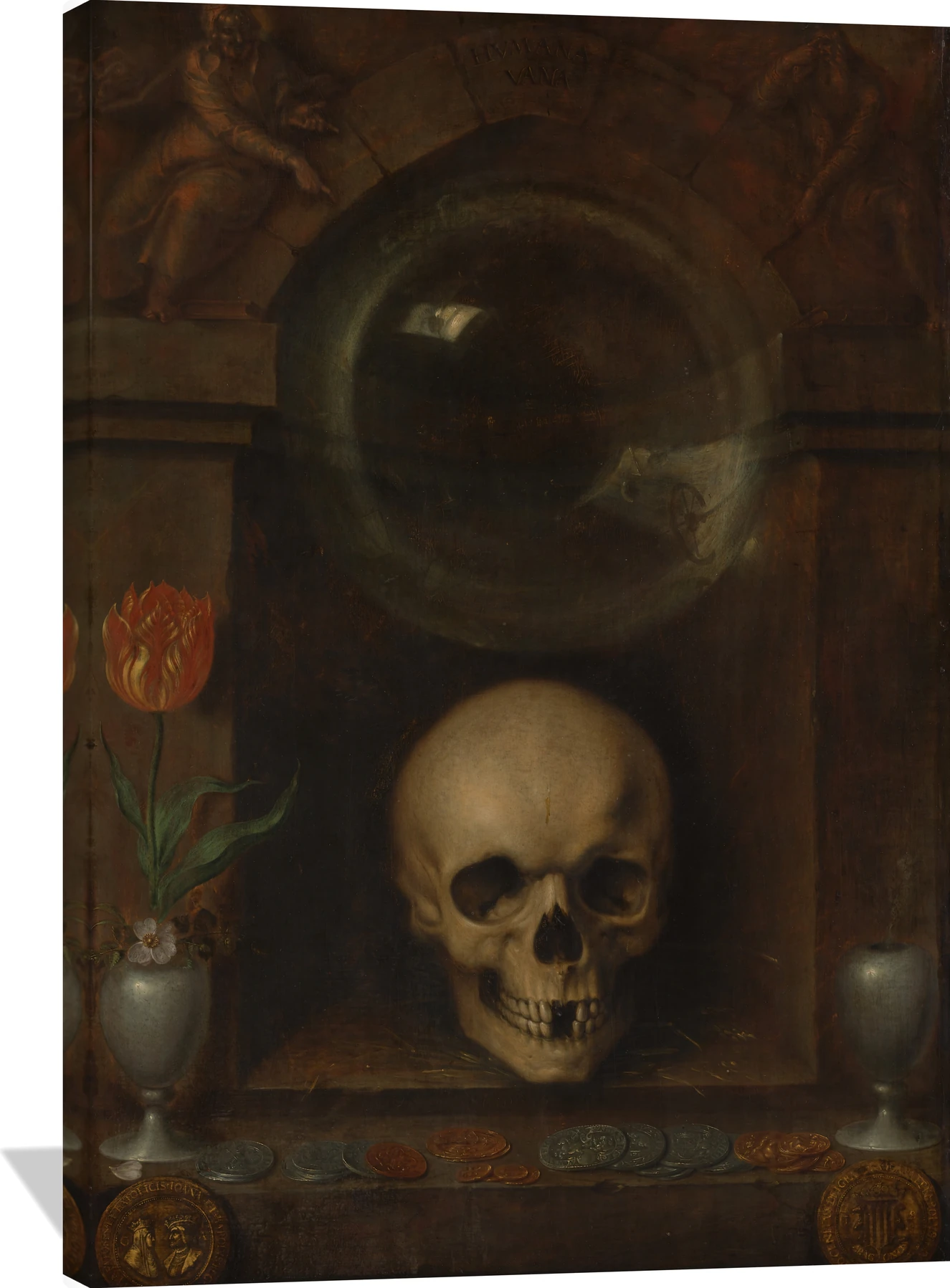
The Jacques de Gheyn II Vanitas Still Life canvas captures the haunting beauty of transience with striking realism. A luminous skull, delicate tulip, and scattered coins emerge from deep brown and ochre tones, evoking reflection on life’s fleeting nature. Subtle highlights of gold and silver add quiet depth to the composition, making it both contemplative and visually captivating.
This masterful wall art brings a sophisticated, introspective mood to any space—ideal for a study, library, or modern living room. A canvas print that embodies the elegance of Dutch Golden Age painting, it invites timeless conversation and enduring style.
Jacques de Gheyn II (Netherlandish, Antwerp 1565–1629 The Hague) was a master draftsman and engraver whose work helped define the flourishing visual culture of the Dutch Golden Age. Trained initially in Antwerp and later active in The Hague, he became renowned for the precision, delicacy, and expressive clarity that distinguished his drawings, prints, and paintings.
Artistic Style and Technique
De Gheyn II is celebrated for a style that merges Northern Renaissance detail with the emerging naturalism of the early seventeenth century. His mastery of line allowed him to capture subtle textures, lifelike botanical forms, and intricate still-life elements with remarkable finesse. His engraved works, in particular, display a technical virtuosity that made him one of the most admired printmakers of his generation.
Subjects and Themes
His oeuvre spans an impressive range, from studies of flora and fauna to allegorical scenes, landscapes, and refined portraiture. De Gheyn II is especially noted for his meticulous depictions of flowers, insects, and natural specimens, executed with scientific accuracy yet imbued with artistic sensitivity. He also produced influential military treatises and imagery, including designs illustrating contemporary weaponry and formations, reflecting the evolving political and cultural landscape of the Dutch Republic.
Notable Contributions
Among his most celebrated works are the engravings after paintings by leading artists of his time, as well as original compositions that reveal his inventive spirit. Series such as his engravings of allegorical figures and moralizing scenes demonstrate both his intellectual curiosity and his ability to fuse symbolic meaning with visual elegance. His drawings, often created as independent works of art, were highly sought after and contributed to the development of drawing as a collectible medium in the Netherlands.
Cultural and Historical Significance
As an artist working during a pivotal moment in Dutch art, de Gheyn II played a key role in shaping the refined aesthetic that would come to define the period. His influence extended through collaborations, commissions, and his mentorship of younger artists. His legacy endures in the exceptional precision of his linework, the sensitivity of his observations, and the enduring impact of his prints, which circulated widely and helped disseminate the visual language of the Dutch Golden Age.
Jacques de Gheyn II remains celebrated today for his distinctive blend of artistry and exacting craftsmanship, qualities that continue to captivate collectors, scholars, and admirers of early modern European art.