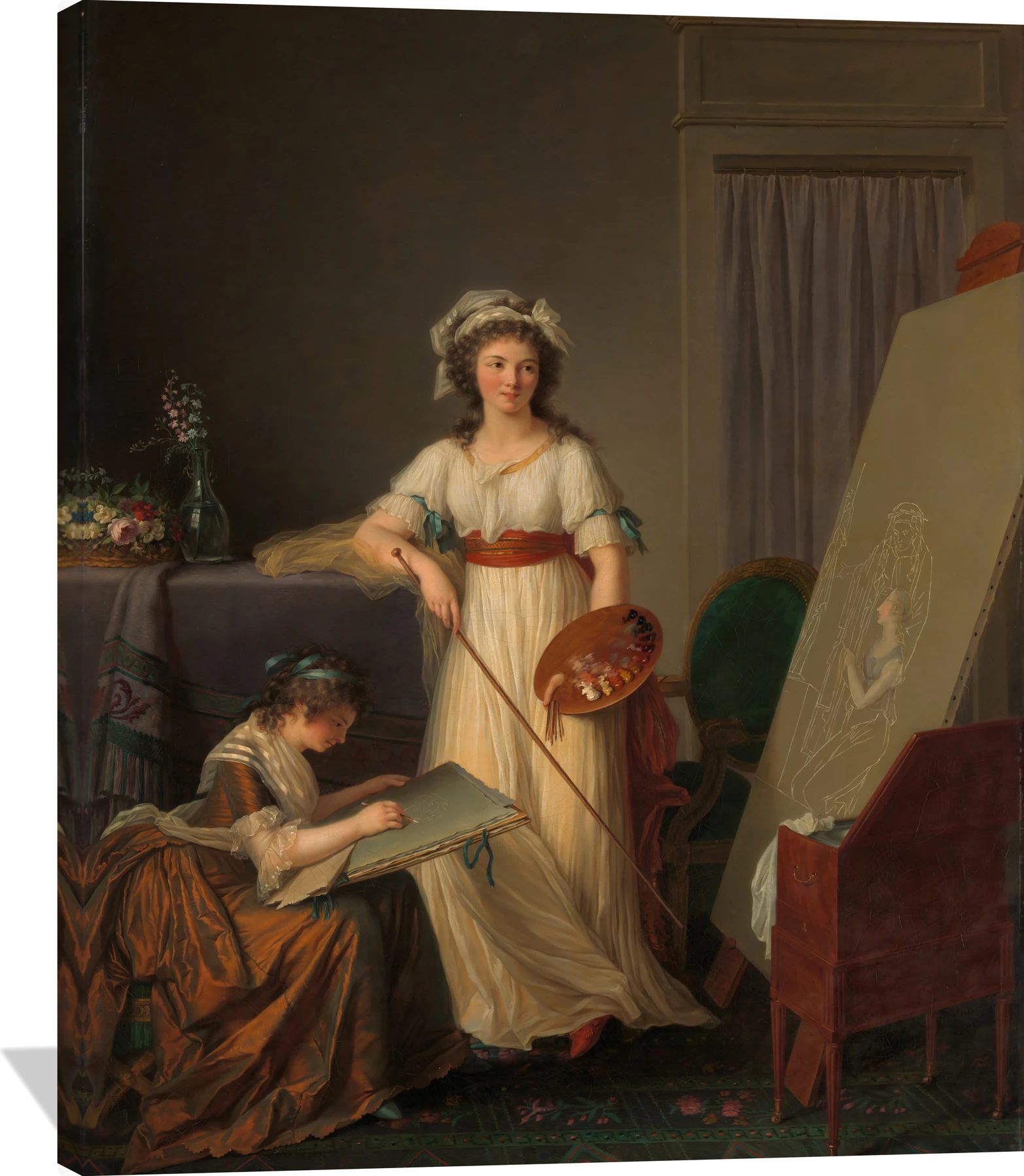
The Marie Victoire Lemoine The Interior of a Woman Painter’s Studio canvas captures a serene glimpse into an 18th-century artist’s world. Soft golden tones, warm ivory, and deep green hues illuminate two women immersed in the creative process, evoking quiet confidence and grace. The refined realism and balanced composition reflect Lemoine’s mastery of light and texture, making this piece a timeless celebration of artistic dedication.
This elegant wall art brings sophistication and calm to any interior—ideal for a living room, study, or entryway. A premium canvas print that honors both the artistry of its subject and the pioneering spirit of its French creator, Marie Victoire Lemoine (Paris, 1754–1820).
Marie Victoire Lemoine (1754–1820) was a distinguished French painter whose career unfolded in Paris during a transformative era for European art. Working amid the cultural energy of the late eighteenth and early nineteenth centuries, she built a reputation for refined portraiture and elegant domestic scenes that subtly conveyed character, grace, and intellect.
Artistic Style
Lemoine’s work is marked by a delicate, neoclassical sensibility, characterized by luminous color, soft modeling, and a poised, uncluttered refinement. Her brushwork reveals a deep commitment to clarity and balance, allowing her subjects to emerge with a quiet yet persuasive presence. This harmonious style places her among the most polished painters of her generation.
Subject Matter and Themes
Best known for her intimate portraits and genre scenes, Lemoine often depicted women engaged in creative or contemplative pursuits. Her celebrated painting The Interior of an Atelier of a Woman Painter remains a key example of her ability to capture artistic life with subtle narrative depth. Through sensitive attention to expression, posture, and surrounding details, she conveyed individuality as well as the social realities of women artists in her time.
Legacy and Significance
Lemoine holds a notable place in art history as one of the women who successfully exhibited at the Paris Salon during a period when female artistic careers were limited by convention. Her work offers a compelling lens into the intersection of artistry, gender, and cultural aspiration in pre- and post-Revolutionary France. Today, she is appreciated for her refined technique, her commitment to portraying women with dignity and intelligence, and her contribution to a broader understanding of artistic life in her era.