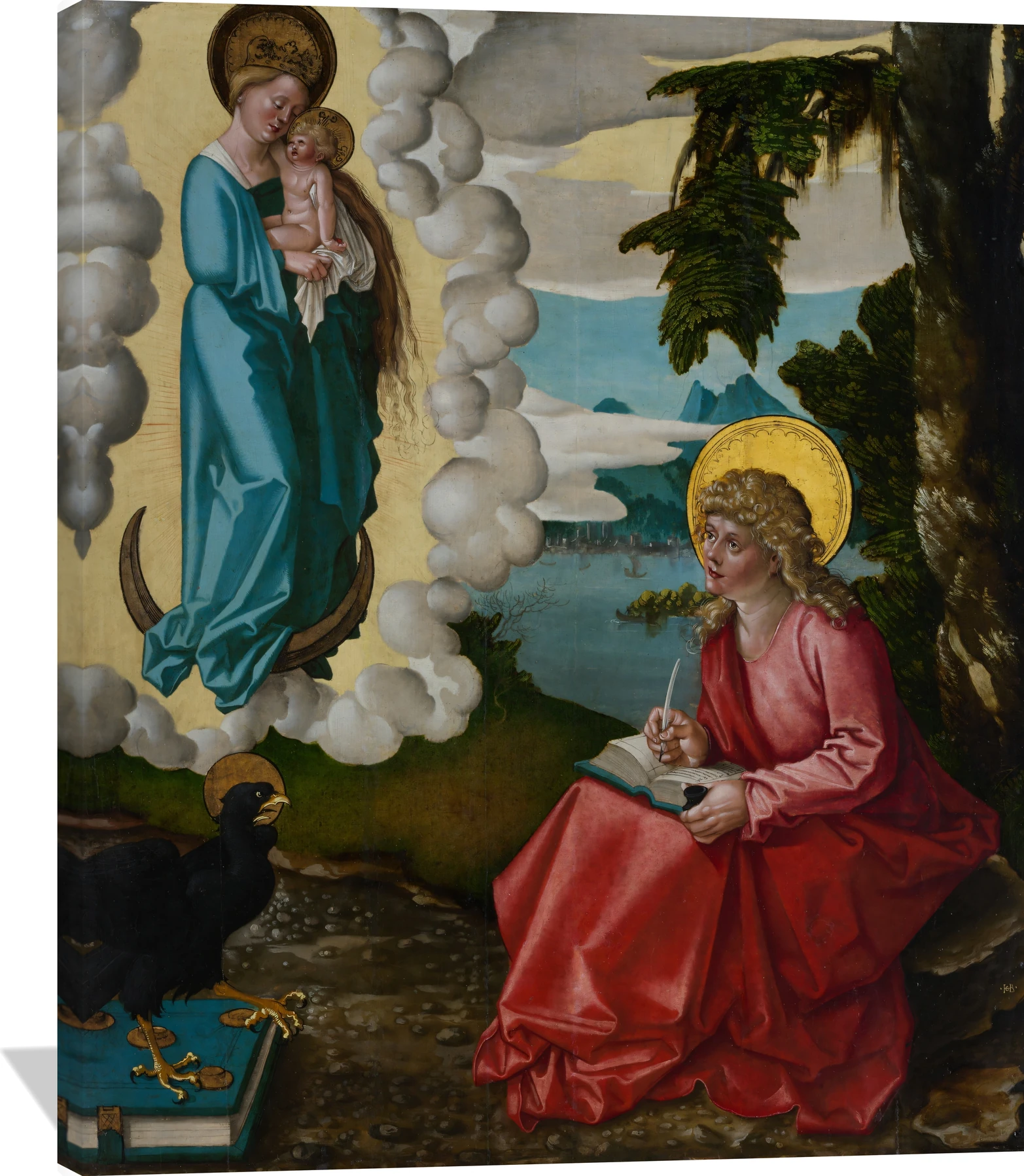
The Hans Baldung Saint John on Patmos canvas captures a luminous vision of divine revelation, rendered in Baldung’s distinctive Northern Renaissance style. Rich tones of crimson, gold, teal, and soft cloud-white illuminate Saint John as he writes, gazing toward the Virgin and Child appearing amid radiant light and mist. The composition’s vertical orientation and serene landscape lend a sense of spiritual depth and balance.
This museum-quality canvas print brings timeless grace and contemplative beauty to any space. Ideal for a study, library, or elegant living room, it invites reflection and admiration through its masterful interplay of color, symbolism, and sacred calm.
Hans Baldung, known as Hans Baldung Grien, was a German Renaissance artist born in Schwäbisch Gmünd around 1484/85 and active until his death in Strasbourg in 1545. A distinctive figure within the circle of Albrecht Dürer, he forged an artistic identity marked by striking originality, expressive intensity, and a fascination with the boundary between the sacred and the earthly.
Artistic Style
Baldung’s work is instantly recognizable for its vivid color, dramatic contrasts, and elongated, dynamic figures. His style blends the precision of the Northern Renaissance with an emotional boldness that sets him apart from his contemporaries. He often pushed beyond naturalism, creating compositions charged with psychological depth and symbolic tension.
Notable Themes and Subjects
Baldung developed a unique reputation for exploring themes that few artists of his time approached with such candor. His images of witches, allegories of death, and sensual, sometimes unsettling, portrayals of the human form captured both moral and metaphysical concerns of the early sixteenth century. Alongside these more provocative subjects, he also produced refined religious works, portraits, and altarpieces, including depictions of the Virgin, saints, and scenes from the life of Christ.
Contributions and Significance
As one of the most innovative artists of the German Renaissance, Baldung expanded the expressive possibilities of both painting and printmaking. His mastery of woodcut technique, in particular, helped shape the medium’s visual vocabulary, pairing technical precision with bold, experimental imagery. Within his lifetime, he earned admiration not only for his technical skill but also for his unmistakably personal vision.
Baldung’s legacy endures through the singular character of his imagery. His ability to unite spirituality with earthly vitality, and beauty with the macabre, gives his work a compelling duality that continues to fascinate viewers. Today, he stands as a key figure in understanding the broader currents of Northern Renaissance art, valued for his inventive iconography and his unmistakably individual voice.