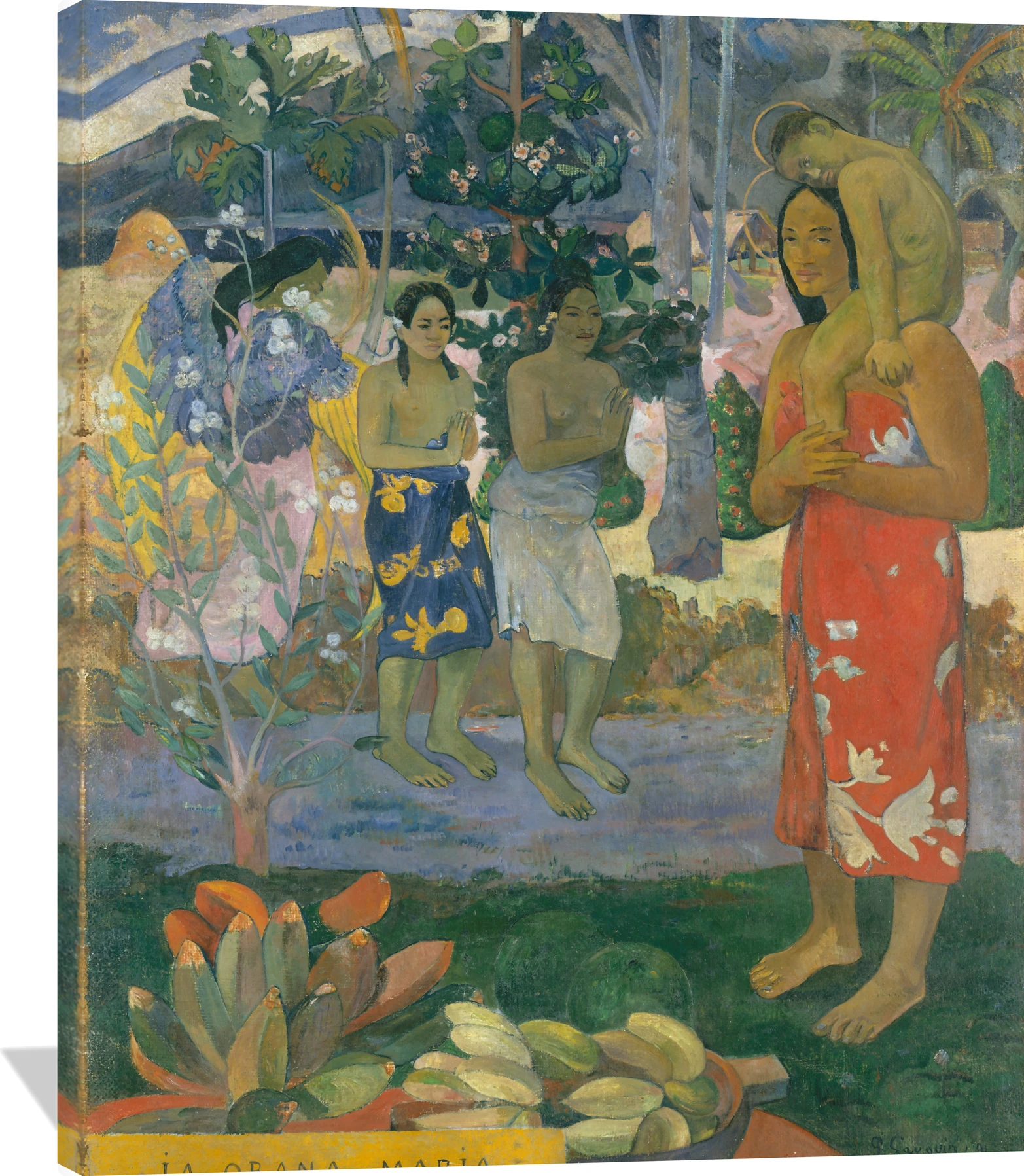
Paul Gauguin’s Ia Orana Maria canvas captures a serene fusion of spirituality and Polynesian life through lush tropical tones of emerald green, coral red, golden ochre, and soft violet. The composition radiates warmth and reverence, as figures stand amid blooming foliage beneath a tranquil island sky, embodying Gauguin’s distinctive post-impressionist style.
This exquisite Ia Orana Maria wall art brings a sense of calm and exotic beauty to any space. Perfect for a living room, study, or entryway, this canvas print invites quiet reflection and adds a timeless touch of cultural elegance to your decor.
Paul Gauguin (French, Paris 1848–1903 Atuona, Hiva Oa, Marquesas Islands) was a pioneering Post‑Impressionist whose bold vision reshaped modern art. Renowned for his pursuit of emotional truth over naturalistic representation, he developed a highly personal style defined by expressive color, flattened forms, and striking compositional simplicity.
Artistic Style and Approach
Gauguin’s work embodies a deliberate break from conventional Western realism. Rejecting optical accuracy, he embraced symbolic color, rhythmic outlines, and distilled shapes to create images that conveyed inner meaning rather than surface appearance. This approach, often associated with Synthetism and Symbolism, became a foundation for many early modernist movements. His use of radiant, non-naturalistic hues and expansive areas of unmodulated color remains one of his most influential contributions.
Subjects and Themes
Drawn to places he believed offered a more elemental way of life, Gauguin spent significant periods in Brittany, Tahiti, and the Marquesas Islands. These journeys profoundly shaped his art. He depicted daily rituals, spiritual motifs, and local landscapes with a blend of observation and imagination, creating scenes that feel at once intimate and mythic. Works such as Where Do We Come From? What Are We? Where Are We Going? capture his enduring preoccupation with humanity’s existential questions.
Legacy and Cultural Significance
Gauguin’s pursuit of a new visual language made him a central figure in the transition from Impressionism to modern art. His emphasis on expressive color inspired artists from the Nabis to Fauvist painters like Matisse. His distinctive fusion of symbolism, emotional intensity, and innovative form has secured his place as a transformative force in modern painting. Today, Gauguin’s work remains celebrated for its vivid originality and its powerful exploration of belief, identity, and the human condition.