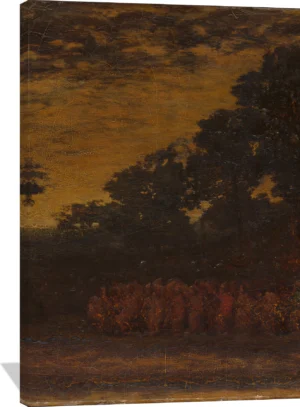
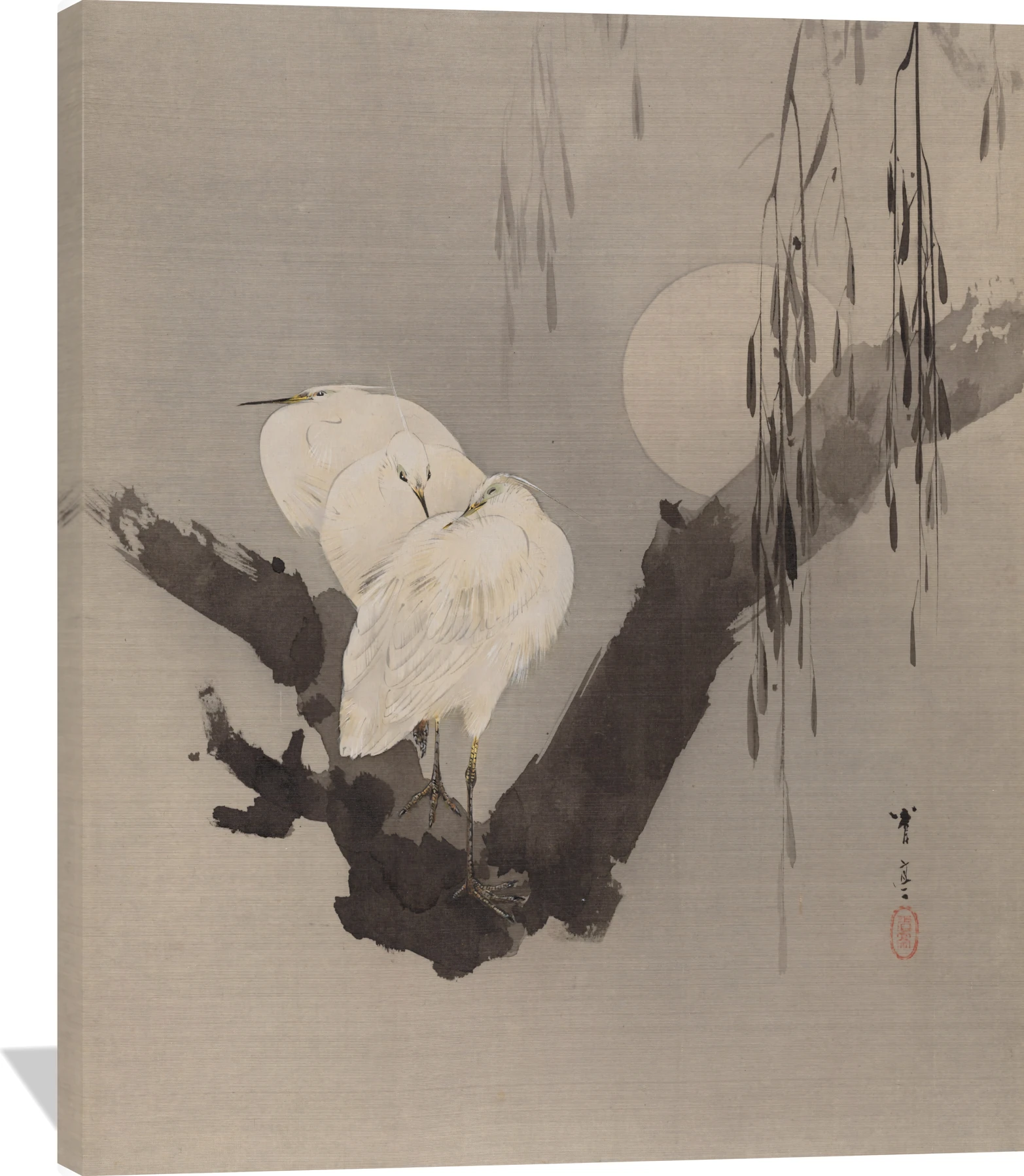
The Watanabe Seitei Egrets in a Tree at Night canvas captures a moment of serene beauty beneath a soft moonlit sky. Three delicate white egrets rest gracefully on a dark branch, framed by the gentle sweep of willow leaves. Subtle tones of ivory, charcoal, and misty gray evoke a tranquil, dreamlike atmosphere that feels both timeless and modern.
This elegant wall art brings quiet sophistication to any space—perfect for a living room, study, or entryway. The Egrets in a Tree at Night canvas print reflects the refined harmony and poetic stillness characteristic of Watanabe Seitei’s Japanese artistry (1851–1918).
Watanabe Seitei (Japanese, 1851–1918) was a pivotal figure in the evolution of modern Japanese painting, celebrated for his elegant fusion of traditional aesthetics with a refined naturalism that resonated both in Japan and abroad.
Artistic Style and Approach
Seitei is best known for his luminous kachōga, or bird-and-flower paintings, which combine meticulous observation with atmospheric delicacy. His works balance classical Japanese techniques with subtle Western influences, resulting in compositions that feel both timeless and fresh. This distinctive blend made him a leading voice in the Meiji-era effort to modernize Japanese art without sacrificing its poetic essence.
Subjects and Themes
Nature was Seitei’s enduring muse. He depicted birds, blossoms, foliage, and seasonal moments with exceptional sensitivity, often capturing fleeting gestures a wing in motion, a branch trembling with life. His illustrations and woodblock prints show a masterful command of line and color, revealing a deep reverence for the natural world.
Legacy and Significance
As one of the first Japanese painters to exhibit in Europe, Seitei introduced international audiences to a modern interpretation of Nihonga. His influence extended through his publications and designs, which helped define a new artistic vocabulary grounded in tradition yet open to global exchange. Today, his work is admired for its serenity, precision, and the subtle vitality that marks him as a key innovator of modern Japanese painting.