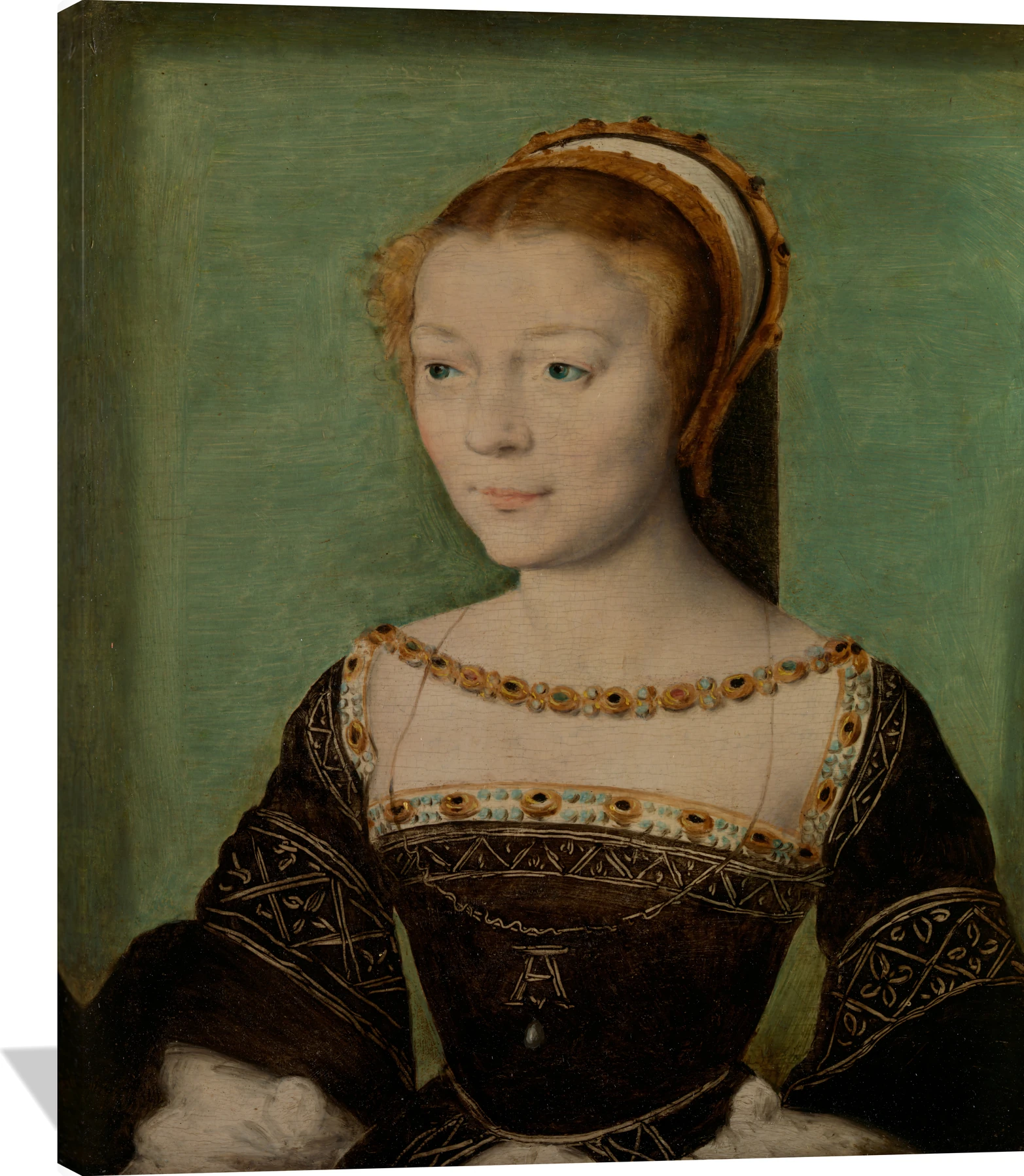
The Corneille de Lyon Anne de Pisseleu (1508–1576), Duchesse d’Étampes canvas captures the refined grace of French Renaissance portraiture. Set against a soft green backdrop, the sitter’s delicate complexion, auburn hair, and richly embroidered dark gown evoke quiet nobility and timeless elegance. De Lyon’s meticulous brushwork and subtle light create a serene, intimate mood that draws the viewer in.
This exquisite wall art brings a touch of courtly sophistication to any space. Ideal for a living room, study, or entryway, this canvas print celebrates the artistry of a Netherlandish master active in Lyons, making it a striking focal point for lovers of classical portraiture.
Corneille de Lyon (Netherlandish, The Hague, active by 1533–died 1575 Lyons) was a master portraitist whose refined, intimate style helped define French Renaissance court painting. Working primarily in Lyon, he became celebrated for his small-scale likenesses that captured both the elegance and psychology of his sitters with remarkable subtlety.
Artistic Style
Corneille’s portraits are distinguished by their clarity, precision, and jewel-like color harmonies. He favored restrained compositions featuring bust-length figures set against luminous monochrome backgrounds, a format that heightened the immediacy of the subject’s presence. His meticulous technique produced exquisitely rendered features and finely detailed textiles, creating an enduring sense of quiet intensity.
Notable Contributions
As one of the key portraitists in mid‑sixteenth‑century France, Corneille became known for his sensitive portrayals of courtiers, diplomats, and members of the royal household. His works offered a new model of secular portraiture in France, emphasizing psychological depth over grandeur. This focus on individuality, supported by his remarkable precision, distinguished him from many contemporaries and secured his reputation across Europe.
Subjects and Themes
Corneille’s typical subjects were prominent figures in the orbit of the French monarchy. Though the formats were often small, his portraits conveyed authority and character through subtle expression, careful lighting, and sharply observed detail. He occasionally produced multiple versions of a single likeness, underscoring his role as a sought‑after visual chronicler of his era.
Historical Significance
Corneille de Lyon played a central role in shaping French Renaissance portraiture. His work bridged Netherlandish precision with French courtly refinement, creating a distinctive aesthetic still admired for its purity and emotional resonance. Today, his portraits endure as intimate windows into the personalities and social world of sixteenth‑century France, their quiet power reflecting the artist’s exceptional command of character and form.